Caspian Hyrcanian Mixed Forests

Caspian Hyrcanian Mixed Forests

Β 

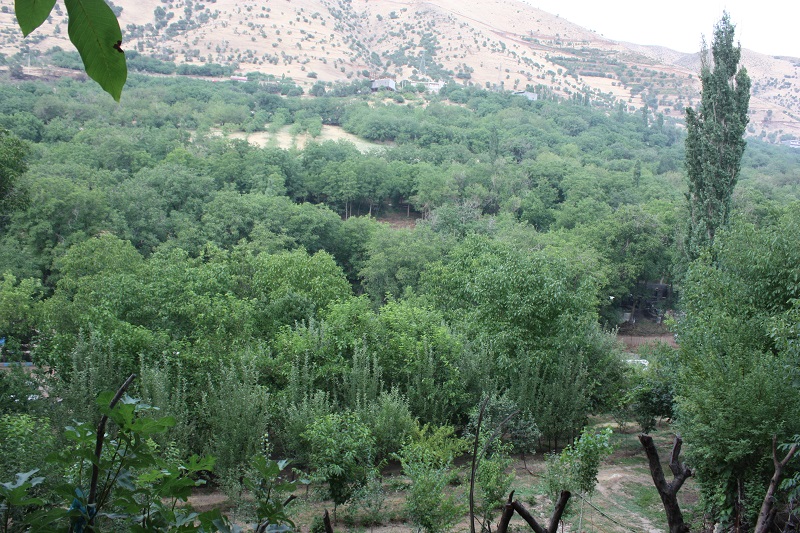
Remained from Ice Age, the Caspian Hyrcanian Mixed Forests region is aΒ  largeΒ  area of green lowlands and massive forests covering about 55,000 squares along the 850 km of the Caspian Sea shore in Iran and Azerbaijan. Most of this forest area is located in Iran.

On July 10th of 2019, the Iran Hyrcanian Forests were registered as aΒ UNESCOΒ World Heritage Site, in Baku.

Β 

Hyrcanian Forest also called Caspian Forest stretched between the northern slopes of theΒ Alborz Mountains and the coastal areas along the Caspian Sea. So, some parts of 5 northern provinces of Iran are located in the west to east of this region including Ardabil Province, Gilan Province, Mazandaran Province, Golestan Province, and North Khorasan Province.

Β 

Β The Hyrcanian ancient broad-leaved forest that belongs to 25 to 50 million years ago covers 7% of Iran land. It is somehow a natural museum. The climate of Hyrcanian forests is humid, oceanic and mountains at the high altitudes. This weather diversity makes this region the home to 180 birds’ species and 58 mammal species such as white-fronted goose, greylag goose, Eurasian spoonbill, white-headed duck, night heron, Little bustard, red-breasted goose, peregrine falcon, Dalmatian pelican, greater flamingo, brown bear, Caspian tiger, wolf, wild boar, jungle cat, golden jackal, badger and otter. The beauty of this pure nature besides the tourist infrastructures such as local restaurants, cafes, ecolodges and recreational sites that exist in this region attract many tourists every year who enjoy, trekking, hiking, camping and … in the paradise of Hyrcanian Forests.

You can follow our LinkedIn account for the news that related Iran and Iran tours.

Β 

Our Caspian Hyrcanian Forest Tour Packages:

Β 

Iran-Austria Relations

Iran-Austria Relations


Since about 160 years ago, Iran and Austria have had a real, low-tension relationship. The most important event between these two countries was Austria hosting for Iran’s Nuclear negotiations, which ultimately led to a final agreement on the Iran nuclear program.

Β Iran and Austria’s diplomatic relations date back to Safavid era, particularly Shah Tahmasb reign in 1552 AD.Β  After the establishment of the Austrian Academy of Oriental Studies, some of the graduates of this center traveled to the Middle East, especially Iran, and began publishing Iranian literature and poetry in the European gathering. Among these graduates, Joseph von Hammer Purgstall was the first who translated β€œHafez Divan” into German. Goethe later considered this translation.

These relations continued during the Qajar era, and due to the pretext of establishing the Academy of Sciences, entered a new stage. At that time, Amir Kabir’s invitation of the Austrian academic professors in the fields of mining and medicine made the two countries closer. In the following years, during the two visits of Nasereddin Shah of Austria, several bilateral agreements were concluded. The main achievements were the conversion of β€œChaparkhaneh” old post office, into a coherent post office, the formation of the police force in Tehran, the construction of a telephone company, etc.

After the victory of the Iranian Revolution, although most European countries had cut their diplomatic relations with Iran, Austria continued the bilateral ties. After the revolution, the first Iranian foreign minister’s trip to a Western country was to Austria. During the Iran-Iraq war, Austria also proved its friendship by accepting the Iranian casualties of Iraqi chemical attacks.

After the revolution, scholarship and free students were dispatched to Austria, and every year more than 1,000 students are enrolled in various universities.

Interactions, communications, and cultural, scientific and academic cooperation are the most prominent relations between Iran and Austria. In other words, one of the main characteristics of the relationships between these two countries is its cultural nature. In this sense, culture is one of the most ancient origins of the Iranian and Austrian associations and has also influenced the political and economic aspects of these relations.

The ancient background of the literary texts and the peoples of both countries’ acquaintance with the cultural, literary and artistic heritage of each other and studies of ancient Iranian traditions in some Austrian prestigious universities and scientific and research centers have had a significant role in the continuation of dynamic interactions and cultural cooperation between these two countries.

Austria was one of the few European countries that refused to adhere to international sanctions imposed on Iran and continued its bilateral trade relationship.

Following the Vienna nuclear deal, The Honorable Heinz Fischer, President of Austria, was the first high-ranking member of the European Union who traveled to Iran.

Our company has also taken practical steps to consolidate these relations. Participation in the Vienna International Tourism Fair, Visiting Modul University Vienna and having several meetings with the managers of this university to exchange professors and students, and knowledge and technology transfers, especially in the field of tourism, was valuable actions that our company has taken to strengthen the knowledge-based tourism relations between the two countries.

Recently to further strengthen this valuable relationship, we had business breakfast hosted by The Austrian Ambassador to Iran in his place, and meanwhile, we received helpful guidance regarding the development of tourism relations.

As Australians are nice people who like Art, especially architecture and music and they are eager to experience local life, the destinations and highlights of this tour are arranged to satisfy them.


A local Academic and Training Institute based on the Global Knowledge

A local Academic and Training Institute based on the Global Knowledge


Gardeshgaran Shiraz traveling agency started its activity in 1999 with a tour license (clause B), and in 2003 obtained a license from Iran Aviation Organization and then became a member of IATA in 2006. In order to serve better services to people who are eager to take part in Tourism Industry, the company established a new academic and training institute in all related fields like tour guiding, hospitality and hotel management and technical management of travel agencies in 2011.Β  Gardeshgaran Sarve Shiraz Institute prepares and trains students not only for their own team but also for related industries. Presently, this team holds more than 55 members of staff and 25 expert professors and teachers as well as 200 students in each semester.

To be successful in training tourism and improve our team mission toΒ conduct a knowledge-based business, we obtain global up to date knowledge and international education by taking part in related international conferences and educational business tours.

Some of these seminars and tours in 2019 are Global Business Forum in Muscat, John C.Maxwell speech in Kish island, Meditation and mindfulness tour in Tibet and Germany business training tour in Hannover and Hamburg.

we also connect with the most well-known and successful mangers of the world in 2019 includes Rory Simpson, Jonathan Low, Dr. Chris Arnold, Pat Mesiti, Mark Colbourne, Cris Beswick, Dr. Richard James, Dr. Dimitri Tsivriko, Alan O’Neil, Michael Ogilvie.

Nowruz, Iranian New Year Celebration

Nowruz, Iranian New Year Celebration

contents Β  Β  Β What is Nowruz? Β  Β  Β Spring Cleaning (Khouneh Tekouni) Β  Β  Β Family Shopping in Nowruz Β  Β  Β Hajji Firuz Β  Β  Β Haft Sin Β  Β  Β Visiting Celebrations Β  Β  Β Iranian New Year Meals Β  Β  Β Sizdah Bedar

What is Nowruz?

Norooz, the Persian new year is a traditional festival marking the first days of spring and the renewal of nature. It is partly rooted in the religious tradition of Zoroastrianism, one of the most ancient religion in the world, and has been celebrated for over 3,000 years. During Noruz holiday families gather to celebrate. It is observed in Afghanistan, Albania, Azerbaijan, Iran, Kazakhstan, Tajikistan and Turkey.


Spring Cleaning (Khouneh Tekouni)

Spring cleaning is called khouneh TekouniΒ in Iran, is the practice of cleaningΒ theΒ house at the same time with the renewal of nature. Weeks before Nowruz, every Iranian excitedly looks up the date and plans for preparing the house for the new year.


Family Shopping in Nowruz

In the Persian new year, renewal is not only about the nature, it is about new clothes and even new furniture. One of the Beautiful ceremonies before the New Year is that all families go out together for shopping and get those requirements that are related to the New Year. Kids are so exited to buy their new clothes for the visiting celebrations.


Hajji Firuz

He is traditional-fictional character for the new year, like Santa Claus, perhaps as a remnant of the ancient Zoroastrian fire-keeper. His face is covered in soot and he is clad in bright red clothes. People gather around him and he dances with tambourines and trumpets bringing glad news of Nowruz coming.


Haft Sin

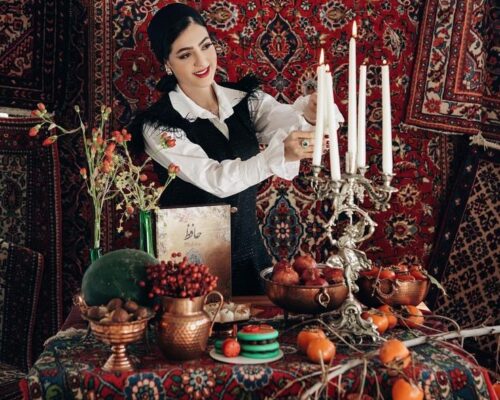
Soferh-eΒ Haftseen is a kind of tablecloth spreading in every Persian household during Nowruz includes seven items starting with the letter β€˜S’ in the Persian alphabet:

Sabzeh” (sprouts), “Sib” (apples), “Samanu” (wheat pudding), “Sir” (garlic), “Senjed” (dried oleaster), “Sumac” (Sumac fruit) and “Serkeh” (vinegar).

You can find other items in this tablecloth like homemade candies, painted eggs, mirrors, flowers and gold fish.


Visiting Celebrations

At the first day of Nowruz (first day of Persian calendar), Iranian families gather around the table of Haft Sin, they kiss each other, and gifts are exchanged. During the next days, the youths visit the senior family members first and then younger ones. This chain of visiting continues to the last day of Nowruz (13th day of the Persian calendar). Usually guests served with nuts, fruits and sweets and the elders give a little money as a gift called β€œEydi” to the kids.


Iranian New Year Meals

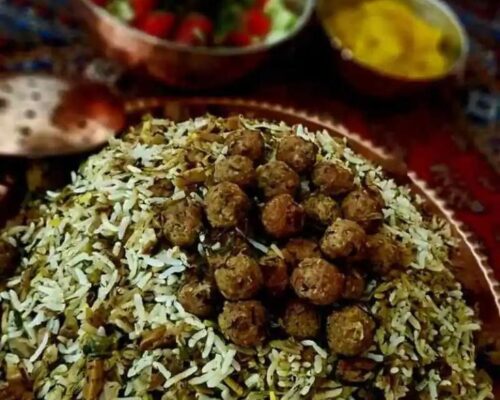
Iranians are used to prepare special traditional meals at the first day of the new year and the whole family gather to have this meal together in cheerful atmosphere. Sabzi Polo Mahi: This traditional meal that is prepared in different cities of Iran for starting the new year celebration is the mixture of rice and fresh green herbs served with fish. Kookoo Sabzi: This is a kind of traditional light and fluffy omelet includes Herbs, vegetable, eggs and walnut. Reshteh Polo: It is prepared in some cities that is rice cooked with a special noodle.

Sizdah Bedar The thirteenth day of the New Year festival is called Sizdah Bedar. All Iranians go on a picnic in the nature. They play music, dance and eat sweets. On this day, people respect the nature and are thankful of its renewal, they throw Sabze in the rivers as the symbol of greenness.

Iran 10-day travel Spiegel Family – May 2018

Iran 10-day travel Spiegel Family – May 2018


Iran 10-day travel Spiegel Family – May 2018

Our family has made a tour in Iran in the first 10 days of May 2018. We were looking for a bit of adventure in an ancient culture unknown to us. To experience something special, but not too far away from home and safe enough for us and our two young children Josephine (8) and Mathilde (6).Β Β 

On an initial exploration of the Internet, we read many enthusiastic stories about Iran. We found an Iranian travel agency, aptly named ‘ Friendly Iran ‘. Via Mail and WhatsApp, we composed an attractive journey with advice from our Friendly Iran travel agent Samane, also suitable for our children.

Friendly Iran has booked for us all Hotels (with breakfast) and arranged all transport with taxis (and 1x Night Train), also to all sights. That all went well and in consultation with the driver we also adapted the program every now and then. For example, just relax in a park if we or the children were tired, instead of a planned visit.

We stayed the first two days in Tehran to ‘ land ‘. Our Hotel Hejab was conveniently located opposite the large Laleh park, where the children could play. Really an oasis in the hustle and bustle of the city. For the children, the Mirror Palace and the young kittens in the Golestan Park were fun. And they certainly remember making fun and playing hide and seek with the guard of the Reza Abbasi Museum, where we have seen a beautiful collection. There was also time to go up the big Tower ‘ Milad ‘ for a magnificent view of Tehran. And to see, in our notion, the chaotic traffic from above.


Our tour went after Tehran via the cities of Shiraz, Yazd, Esfahan and Kashan. A ‘ classic ‘ round it seemed afterwards, so evident from the meetings with other travellers in the hotels.

From Tehran train station we left at the end of the afternoon by night train to Shiraz, which is about 900km to the south. Train travel is really something for me, but I believe there are more people that have an adventurous feeling with the idea of travelling through the Persian night by train. Ok, it was not a new train, but we had clean bed linen and the chicken with rice and salad that we got tasted very well. We talked a lot with other travellers in the wagon, like the boys who were with their teacher on a school trip and with the owner of an English language institute from Qom. All curious in our opinion about Iran.


From Shiraz on we had a good English-speaking driver, named Mohammed Dehghani. It is really nice if you can communicate well with your driver and that he also feels where the children (and parents…) are on. We certainly had such a good driver with Mohammed. He also had young children and found it extra fun to travel around with our family. He was not only a driver, but also our interpreter, money changer, negotiator and consultant in many areas. We spent a lot of fun hours in his white Samand taxi, and the girls in the backseat and me next to him.


We did not have a fixed guide for our entire travel program, but with help of the driver and via Friendly Iran we hired a guide for places where it was necessary. For one day we had a very good guide in Esfahan, Mr. Peshman Azzizi.


In Shiraz we stayed at the Niayesh Hotel, with beautiful stained glass, romantic indoor places and exciting passageways all of which were explored by our children. In Shiraz we visited several beautiful mosques, the Vakil Bazaar and the Naranjestan Palace. The next day we went on excursion to Persepolis, where we had our own guide. The palace ruins of Persepolis are really quite impressive due to its size, old age (2,500 years old) and beautiful reliefs and statues. The children also found the fantasy creatures, like the sphinxes, very beautiful.


In Shiraz we also ate in the family home of our travel agent Samane, together with her mother, sisters, a few colleagues and a colleague’s nephew. I helped a little with cooking. The mother of Samane had prepared a dish called ‘ Fesenjan ‘, with chicken, pomegranate syrup and walnuts. We ate together sitting on the ground, on a Persian carpet. Our children played with the sisters of Samane and with the nephew of her colleague.


The day after we went to the town of Yazd, which is close to the desert. En route along the tomb of King Cyrus the Great (of which Josephine later bought a snow globe as a souvenir) and drank tea in a tent with a nomad family with sheep, in a beautiful rugged area. With a picture of us in traditional attire and for the kids a nice bracelet. We discovered that there are more types of pistachio nuts.


In Yazd we stayed at the Royay e Ghadim Hotel, again with a beautiful courtyard. We have climbed the ‘ Towers of Silence ‘ with the children, the place where the Zoroastrian community brought their dead. Impressive to stand on top of the towers and know the story. Near Yazd we have visited a desert camp and made walks, the children also on a camel. It felt really good to be β€˜out’ in the desert; sleigh riding and rolling down from sand dunes for tour children and we all enjoyed the sunset. We ate in the evening at the campfire, until suddenly a violent thunderstorm with sand storm drove us inside. Definitely not good for people with contact lenses, like me.


From Yazd, Mohammed brought us to Esfahan (Isfahan). On the way in the town of Meybod we visited Narin castle, the first parts of which could be built 4,000 years b.c. The legend wants this castle to have been inhabited by King Salomon.


In Yazd we stayed in the Atiq hotel, with an excellent breakfast buffet and again a traditional palace with beautiful courtyard. Esfahan impressed us with its beautiful large squares, bridges, beautiful mosques and palaces. We also visited the Vank cathedral in the Armenian Jolfa district, with afterwards the most delicious (and thickest) hot chocolate in the world.

Everything was even more appealing to the imagination in Esfahan by the explanations we got from our great guide Peshman Azzizi. Again, in Esfahan we had lots of nice contacts and ‘ photo moments ‘ with Iranians.


From Esfahan we travelled to Kashan for our last night. In Kashan we bought souvenirs (oil lamps) and visited a hammam and a beautiful 18th century merchant house.


The next day, unfortunately, we had to go back again to the ‘ IKA ‘ airfield of Tehran. On the way we bought delicious pistachio biscuits and had a farewell lunch with Mohammed our driver. He was sure that we would come back again. We have that feeling too; The goodbyes made us really grief.


We felt safe and comfortable throughout our entire journey in Iran. Of course, you have to surrender in traffic to the driver’s knowledge and all other Iranian drivers, who must have a great deal of confidence in each other, in view of their driving style.

The main thing is that we had a great Persian journey with our family and we have never experienced a holiday with such a friendly and interested population as in Iran. Next time we would like to take a less classical route, with some more nature, perhaps by the sea (Persian Gulf or the Caspian Sea) and a longer stay in the desert. Anyway, there is still a lot to discover in Iran. We just got a corner of the veil for ourselves, in a beautiful may holiday.

Edward and Sieneke Spiegel, and our daughters Josephine and Mathilde

Zwolle, the Netherlands


β€œSilk Road” the Ancient Trade Network

β€œSilk Road” the Ancient Trade Network


TheΒ Silk RoadΒ (Silk Route)Β was an ancient network of trade routes founded during theΒ Han DynastyΒ ofΒ China, that went through the regions ofΒ Eurasia and linked them in commerce. While many kinds of goods traveled along the Silk Road, the name Originated from the silk which was the Chinese Valuable commodity. The Silk Routes expanded from China throughΒ India, Asia Minor, Mesopotamia, Egypt, the North African continent,Β Greece, Rome, andΒ finally Britain. The northern Mesopotamian region (present day Iran) was China’s closest trade partner, and they initiated important cultural exchanges. These ancient roads had no particular name. In the mid-nineteenth century, Baron Ferdinand von Richthofen, the German geologist, named the trade and communication networkΒ β€œthe Silk Road”. It was supposed a safe trading network of roads and even the Chinese extended their great wallΒ to ensure its safety.

The roads were used from 130 BCE, when theΒ HanΒ officially established trade with the west, till the OttomanΒ EmpireΒ prohibited trade with the west and closed the roads.

The history of the Silk Road refers to the time before the Han Dynasty, known as the Persian Royal Road, which was of the main thoroughfare of the Silk Road. It was established during theΒ Achaemenid EmpireΒ (500-330 BCE). The Persian Royal Road stretched fromΒ Susa, in PersiaΒ (modern day Iran) to the Mediterranean Sea inΒ Asia Minor (modern dayΒ Turkey). There were postal stations along the route with fresh horses to deliver messages throughout the Persian empire, quickly.

HerodotusΒ (413/425 – 484 BCE), about the efficiency and speed of the Persian messengers, wrote that:

β€œThere is nothing in the world that travels faster than these Persian couriers. Neither snow, nor rain, nor heat, nor darkness of night prevents these couriers from completing their designated stages with utmost speed.”


The Persians protected the Royal Road attentively and expanded it through smaller side roads. These routs eventually stretched from east into India, and from west intoΒ Egypt.

In addition to the silk, also spices, textiles, grain, fruits, vegetables, animals, tools, metal work, wood work, art work, gun powder, religious objects, precious stones, and much more were traded through the roads. The greatest legacy of the Silk Road was the exchange of technology, language,Β Art,Β religion,Β culture, philosophy, science, architecture, and every other civilizationΒ element beside the commercial commodities. The main traders in the road were theΒ Persians, Chinese, Jews, Arabs, Greeks,Β Bactrians, Syrians, Turkmens, Indians, Romans, Georgians, andΒ etc.

In the Dark Ages, caravans traveled through the silk roads were welcomed in large guest houses, so they had opportunity to meet other merchant travelers, and exchange cultures, languages and ideas.

Caravans’ travelling continued until the 19th century. This caused a network of caravanserais to be formed in China, India, Iran, Turkey, the Caucasus, North Africa, Russia and Eastern Europe. Many of them still stand. In the nineteenth century, a new type of travelers such as geographers and archaeologists explored the Silk Roads. Regularly, they were from France, England, Germany, Russia and Japan.


Iran on the Silk RoadΒ 

The silk road enters Iran through Khorasan and passes Tous, Nishapur, Sabzevar, Shahrud, Damghan, Semnan, the ancient Rey and Qazvin, and from there it is divided into two branches. One path goes toward the Northwest through Sarab, Tabriz, Marand and Khoy and afterward out of Iran. The second path stretches to Hegmataneh (today Hamedan), Kermanshah and exits from the west of Iran.

In the recent decades, UNESCO has tried to revive the silk road in the countries including Iran that form the chain loops of this precious heritage. Simultaneously, Iran government has taken effective steps to develop the road to become one of the major tourist destinations of Iran. In this regard, Nowadays the tourists are more interested to travel to this road and pass through the same road that their ancestors did and experience caravan journeys and visit ancient structures such as Caravansaries, water cisterns, cafes, shrines, castles, springs, sanctuaries, cemeteries, baths, markets, aqueducts and even the remnants of road and bridge flooring. If you are eager to explore the silk road, Friendlyiran offers a Comprehensive tour package including en route cities, towns and historical sites.


IS IT SAFE TO TRAVEL TO IRAN AFTER TRUMP’S TRAVEL BAN??

IS IT SAFE TO TRAVEL TO IRAN AFTER TRUMP’S TRAVEL BAN??


An Iranian Adventure

By Mike Rudge


When Margaret and I told people we were going to visit Iran, the common response was along the lines of,

β€œYou’re what! You must be mad. Trump is about to bomb the place.”

But we had paid the fares, bought our travel insurance and collected our prescriptions, so backing out from our visit to the cradle of western civilisation was not an option.

If the venue had an unbelievable touch, so did the flight from Auckland to Doha. It is the longest commercial flight in the world, taking the equivalent of over two working days, sitting on one seat. Fortunately, Qatar Airways is a superb airline, providing great service and excellent food.Β Doha, the capital of Qatar, is a major hub for flights all over the world. The airport oozes wealth and superb architecture, and its arrival/departure boards are a multi-choice geography test. The flight from Doha to Tehran, capital of Iran, was a wonderful geology lesson that was amplified later as we toured by road. The land is contorted into ridges, folds, rifts and mountain ranges because three tectonic plates collide in this region. Politicians are not the only source of pressure on Iran.

Unlike New Zealand, which is surrounded by sea, Iran has land borders with six other countries, and is near neighbour to at least six more, whose religions, politics and history bring various degrees of friendship to everyone’s relationships. History is at the very heart of Iran, because the country today is the core of what were fluctuating Persian empires spanning more than 3,000 years. At its largest, β€˜Persia’ reached from Delhi to the Danube, but some of the greatest names in the history of bloodshed have also imposed their wills upon Iran – Alexander the Great, various Roman Emperors, Genghis Khan, Tamerlane, the Ottomans. I wondered if today’s despots seem like β€˜more of the same’ in the cultural memory and psychology of this country.

Though Kings and empires have come and gone, one constant feature in Iran, and a wonder for tourists today, is the Paradise (=Persian) Garden. The first one was created at Pasagarde in about 500 BC, and its remnants are still discernible today in a semi-desert that was a fertile valley at that time. The basic concept of the Persian Garden – water, trees and flowers – came to be expressed in many ways, at mosques, palaces and homes. Long, reflecting pools, waterfalls, fountains and bubbling channels sit within flower beds and slender cypress trees. One of the finest is the Shah Zadeh garden whose tranquillity arrests the onward rush of even the most ardent tourist. But, beguiling though the Paradise Gardens are, two great centres, the ruins at Persepolis and the mosques and palaces of Esfahan, are the tourist magnets.


Iran is rich both in ruins from past civilisations and in glorious Islamic architecture. Many of both are UNESCO World Heritage Sites. Perspolis, is the remains of a palace complex conceived 2,500 years ago by King Cyrus who wanted to display the might of his Persian empire to emissaries paying homage. Cyrus brought designers and artisans from the far corners of that empire. The result, with additions by later Kings, includes great staircases, monumental gateways, friezes carved in stone, statues, and tall columns that are the only remains of many buildings. Persepolis stood in a fertile area then but, in a drying climate, the exquisite stone carvings look as sharp now as when skilled artisans created them. Another ambitious empire builder, Alexander the Great, burned down the wooden interiors in 330 BC, so that today we see only the imposing stone remains, standing above the desert on their platform of massive blocks.

The top tourist destination in Iran is Esfahan, a city of craft artisans, tree-lined boulevards, Persian Gardens and spectacular Islamic buildings. Hundreds of metres of covered bazaars are a shopper’s paradise. Metal and stone craft, works of art, fabrics, carpets, domestic ware, meats, jewellery, a huge array of fruit and vegetables, and sacks and bins of indeterminate spices, are all there in profusion. You can watch silver being engraved, copper being beaten, and semi-precious stones being set. The sights, smells and sounds are marvellous. Long arcades and domes show that architectural skill, and unending imagination in brickwork and coloured tiles, are not confined to mosques and palaces.

Driving around Iran, it is impossible not to be struck by sharp transitions in the landscape. In the valleys, grow cereals, figs, pomegranates, melons, and many vegetables. Within metres, when the slope changes, this fertile scene becomes semi-desert (with occasional flocks of sheep and goats), rocky slopes and mountain ranges. Layered rocks speak of an ancient land that has risen from the ocean, and the Great Salt Desert is further evidence of that. Enormous forces contorted those rocks into folds, and even pinnacles where erosion has eaten into softer layers. It is hard to imagine vibrant cities, great civilisations, and the productive land that would have supported them and their armies, where now there are barren landscapes and ruins. Everywhere in Iran, it is clear that water is as crucial today as it was in the rise and fall of great empires of the past.


Politically, Iran is a theocracy governed by Shi’ite clerics who gaze down severely from billboards and buildings. Women, including tourists, must observe Islamic dress codes, such as head scarves and long gowns, but a younger generation is testing the boundaries with elegant garments that more or less comply. Alcohol is forbidden, but we adjusted quite happily, and realised how big a part alcohol plays in New Zealand society. Iranian food, and its gentle spices, is almost a vegetarian delight, with many dishes based on aubergines, tomatoes, lentils and beans, with or without meat.

Even though English-speaking TV stations are rare in Iran, political matters were always evident. The effect of financial sanctions (over nuclear enrichment) was demonstrated all around the country by incomplete roads, bridges and buildings. General neglect is apparent, too, except in major tourist sites where restoration work is done with admirable support from UNESCO. While we were in Iran, Israel breathed aggression, and the USA announced yet tougher sanctions, but many other countries denied that Iran had breached its nuclear treaty obligations. Such is life in Iran. For us, coming from a land bordered only by benign ocean, it was strange to share at first hand the threats from nearby powers, and from a greater power so far away. The people of Iran do not need them, and probably do not deserve them.

Our local tour company was called β€˜Friendly Iran’, a name that truly reflects our experience of that country. Amir, our superb Iranian guide, assured us that we could walk anywhere at any time without fear for our safety. On the street, and in Persian Gardens, bazaars and mosques, we were welcomed. Children called β€˜hello’, and they scampered away laughing when we said β€˜hello’ back; teenage schoolgirls with smiling faces framed in headscarves, wanted to talk English, pose for photos and laugh in delight; adults extended their hands and asked us where we were from. Many of them knew where tiny New Zealand was, and that it was a beautiful country. They were appreciative that we had travelled from so far away to visit their country, despite what we may have heard about it, and what might happen to us. Iranians must be some of the friendliest people on earth, and anyone who visits their ancient and extraordinary country will be sure of a welcome.


Big Group Tours to Iran

Big Group Tours to Iran


β€œHow nice it would be if the whole world comes together as one happy family, if we could all keep sharing all the things we have – what joy, what peace, what contentment!”

A very Meaningful and nice statement from a community called Samratchana (means “Total Protection”) in Chennai, India, where β€œBaba” and his followers try to bring the whole world under one roof and live with love. They believe we are brothers and sisters and children of God. The campus houses a few Hindu temples, a mosque, a church, a Buddha temple and a Jain temple. They also travel to know the humans all over the world and send them peace, friendship and love messages.

Baba and the community are interested in spirituality and religion, and travel to different religious and holy places, visiting holy shrines and temples and meeting religious leaders.

Iran is a country full of different cultures and religions and a lot of holy places like ancient mosques, cathedrals, fire temples, Synagogue, holy shrines and ancient cemeteries. Friendly Iran group would happily arrange an itinerary to cover the interests of these kind of communities who are eager to travel and explore the mentioned places.

We can happily plan and customize your itinerary for Iran group tourΒ such as big families, huge group of friends, community members, cult followers and the affinity groups with common interests. Based on your interests we can tailor-made the tour schedule and provide your required services to visit your favorite highlights in main cities and even arrange your tour to explore remote attractions with your preformed group at reasonable pricesΒ under your budget limit.


As a consequence of forming a large tour group, friendly Iran would offer special discounts upon Iran tour expenses covering accommodation, catering, tour escort, transferring, Iran visa services and Iran travel insurance fees.

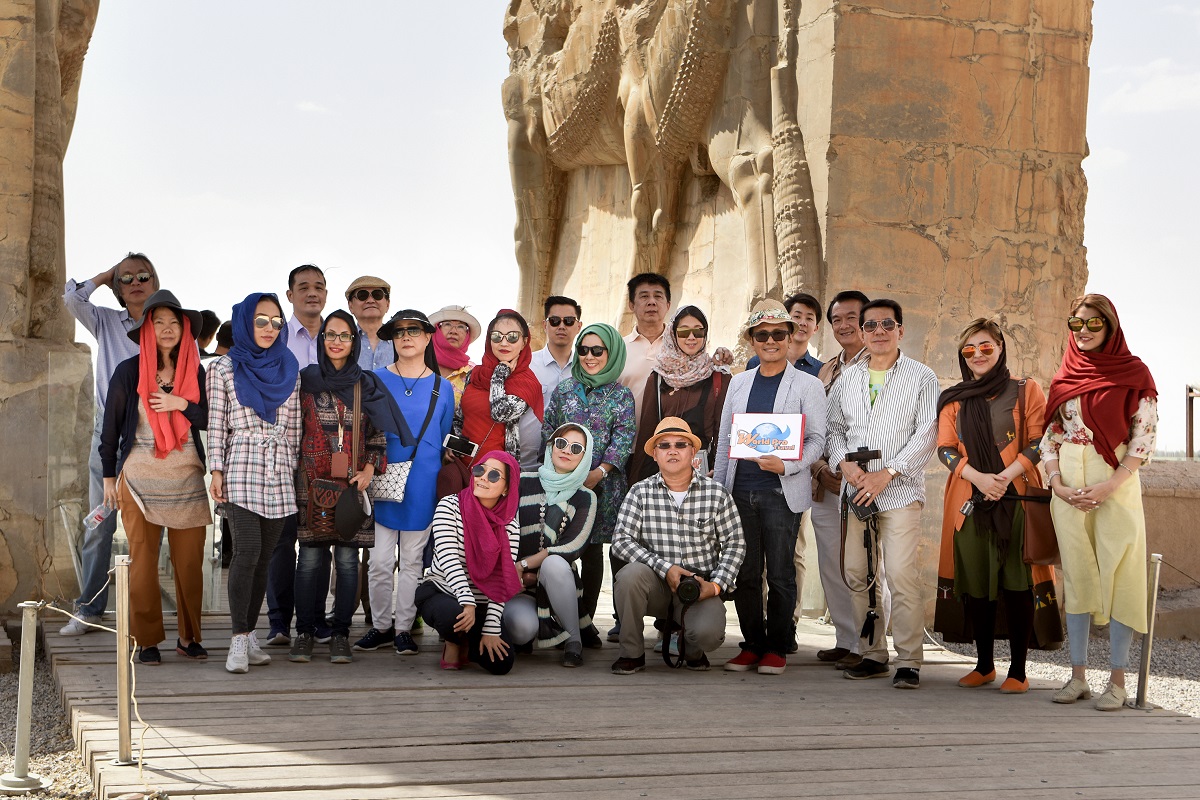
In May 2018, one of Indian community members and their β€œBaba” (Siva Shankar Baba), formed a large group tour (25 passengers), traveled to Iran and visited the main cities and their highlights. We are proud to have been their host, and provide their required services, based on their interests and budget limit.


Is Iran a family-friendly vacation destination?

Is Iran a family-friendly vacation destination?


Tourism has potential for being a long-term activity for the planet. So, the kids who are the future kings of the earth play a significant role in this activity. WhenΒ weΒ planΒ ourΒ familyΒ holidays,Β ifΒ weΒ consider travelling with our childrenΒ we should provide the situation for them to have fun and learn during the trip, itΒ willΒ bringΒ usΒ closerΒ toΒ responsible tourism and leads us to aΒ more sustainableΒ world and the third generation of tourism called Creative Tourism. Traveling with your family and kids is wonderful mixture of recreation and education.


When you think about traveling to Iran, as a cultural destination in the middle east maybe you do not consider it as a kid-friendly destination. That is not true! There is no need to leave your beloved children at home with a babysitter or their grandma! Do not hesitate to bring your kids to Iran because:

  • Iran is great for family holidays, children are most welcome, and Iranian adore babies.
  • Iran is a safe destination in the middle east.
  • Iran has plenty of diverse recreation and entertainment sites to go with kids and teenagers such as museums, aquariums, amusement parks and also specific natural sites like Qeshm geopark for unique geo-based attractions and Lut-desert for trekking and safari.
  • Iran is a reasonable destination for families. This opportunity gives the most of travelers the potential to book private services during their Iran visit. A private driver with a knowledgeable guide help to get the most out of every sites, minimize transfer times, and maximize fun with family.
 

Iran Family-Oriented Accommodation

Your accommodation in Iran can also be an attraction itself. You can stay together in family suites of boutique hotels or Eco-lodges in the small towns and villages, traditional houses and nomads or desert camps. No matter where you stay, it will be of good quality as standard and more. Besides the mentioned advantages, the prices in above types of accommodation are so reasonable for families. As the kids are usually fussy eaters, we can ensure that colorful Iranian cuisine makes them enthusiastic to experience new tastes and eat well. If you have a big family who are eager to explore Iran with kids, we in friendlyiran can happily plan and customize your itinerary for family tours andΒ group tours to Iran.


Christmas in Iran

Around 25th December to the 6th January, at the time that Christmas holidays coming, the Armenian residency and fashionable shops turn on a new decor and make a pleasant vibe.

In Armenian district the smell of doughnuts and coffee comes from little confectionaries, making every passenger set foot in the shop and buy some delicious sweets. Energetic mothers with their children looking for chic clothes and charming gifts, walk in the streets, laughing and enjoying their time.

The official religion of Iran is Islam and majority of Iranian people are Muslims, yet Iran population have about 3 hundred Christians who are freely living in Iran, believing in their religious heritage. Moreover, They Celebrate Christmas every year, attending church services, decorating their houses with pine trees, lights and Santa doll and gathering together as a family.

Jesus Christ is a highly respected prophet in the world of Islam and Christmas is also an exciting event for Muslim youths. They go shopping in Armenian quarters, congratulating New Christian Year to their Iranian and non-Iranian friends.

Most of Azerbaijan Province was the residential district of Armenian people from the ancient time, and about 180 lovely and beautiful churches located in this region. Some of these Churches are UNESCO world heritage, named The Armenian Monastic Ensembles of Iran, in the north-west of the country, consist of three monastic ensembles of the Armenian Christian faith: St Thaddeus and St Stepanos and the Chapel of Dzordzor.

From early times that Christianity came to Iran, so many Armenian merchants made deals with Indians through Bandar Abbas and Shiraz.

The most beautiful Christmas festival in Iran is held in Armenian Quarter of Isfahan, which named as Jolfa! It feels like you are in Armenia when you walk through the pavement in the Jolfa region. There, people speak their mother tongue, Armenian language, with an adorable accent. The cosy shops are just the same as Armenian shops. Have you ever heard about Armenian coffee? Coffee shops in Jolfa region serve a tasty coffee. There are some famous churches located in Jolfa Area, such as Vank cathedral and St. Mary Church. Christian New Year holiday in Iran, visiting Iran historical places while you make yourself at home!

How We Celebrate Christmas in Iran

On 1st of Jan, The ceremony of sacrifice begins. Families enter the yard of churches, kiss the relatives. Children play, and adults do greetings. At the exact time of 12:00 when bells ring, the sound of silence is all you will hear, everybody looks at the sky and pray, turn on candles, then people sing a traditional song while their tears wash out their faces.

On 5th of Jan, Armenians break their fasting, doing communion in Church. For the consecration, they give some butter to families to add to their meals.

In the Christian New Year eve family members gather together around the Christmas tree and pray and then attend to church services. Pine trees ornamented by colourful glass balls and shining lights. Under the Christmas trees, there are always gifts. Some family members put on Santa clause clothes, and some hire a Santa clausΒ to give presents to the children.

Are you planning to spend Christmas holidays in Iran?

Joining Iranian Christmas in the holiday is a new experience that is different than all Christmas times that you ever had. Every year stylish tourists who like to try new things don’t lose the opportunity of joining Iran Christmas tours in 2018. During this Christian holiday, you can still do Christian communion, ceremonies and join the gatherings with lovely Armenian Christians. A fabulous beginning to the New Year 2018, in Persia!

This Iran tour for Christian New Year holiday is fixed in the Vacation time, but via ignoring the Iranian Christmas celebrations in Isfahan, you can have the same tour in all time of the year!

Why ShouldΒ YouΒ Not Miss Persian Christmas Tour Package?

During Christmas time, it’s low-season in Iran, and you can make a great Iran tour deal through FriendlyIran tour operator!

You should choose a travel agency in Iran that have competent programs, especially in this great Christian holidays.

From 24th of Dec to 6th of Jan, when the schools are closed, and it’s time to give yourself an easy time to go on a trip, Go ahead and make your decision to be in Iran for this Christmas! Don’t let yourself wondering where to go! The next destination for 2018 New Year holidays is Iran!

FriendlyIran Travel and Tourism Agency operates customized tours to have a special New Year holiday in Iran, which will be beyond your imagination! We’ve got so much interesting plan and surprises for you! Taste the Merry Christmas in Persian- Christian Style!

[/vc_column_text][vc_column_text]

Good to know

Iranian new year . .

Christmas in iranΒ pictures

Join us in new year Β holiday tour package

7 Things to know about Iran Tourist Visa on Arrival in 2018

How to get on arrival Iran visa in 2018? Is it necessary to have Iran visa as a permission to enter Iran? So many tourists who plan to travel to Iran wonder; how and when to proceed to get Iran visa? And, How to get Urgent Iran visa for travelling?

This article is about most important tips to get Iran visa (Iran tourist visa) and hints to have Iran visa on arrival.


iran visa

  1. Who can get Iran visa on arrival?

Tourists who are planning to visit Iran, can have their visa on arrival at Iran international airports. Iran visa on arrival for Diplomats, Officials? Iran visa on arrival is specified to tourist type of visa. Diplomats, official passport holders cannot have visa on arrival to Iran. Which nationalities can have Iran VOA? Most of the nationalities can have Iran visa at the airport.

Which nationality cannot have VOA of Iran? USA, UK, Canada, India, Colombia, Somalia, Jordan, Bangladesh, Iraq, Afghanistan, Pakistan passport holders cannot have Iran visa on arrival.

  1. Where can we get Iran visa on arrival?

Tourists can have their Iran visa on arrival stamped on their passport in all international airports in Iran, Tehran Imam Khomeini (IKA), Mehrabad (THR), Shiraz (SYZ), Esfahan (IFN), Mashhad (MHD), Tabriz (TBZ) and Kish (KIH).


  1. Requirements and Needed documents for Iran VOA Visa?

Requirements for Tourist visa on arrival are:

  • A passport with validity of 6 months from the arrival day
  • Personal photo with a white background
  • Visa fee; the cost of visa on arrival for each nationality is different


  1. How much Iran visa on Arrival costs?

If you want to have Iran visa on arrival you will skip the Iran visa service, which is normally 45 Euro.

In any case, tourists should pay a cost as Iran visa stamping fee.


The Iran visa stamp fee for Germany, Spain, Italy, Austria, Slovenia, Czech, Denmark, Romania, Sweden, Swiss, French, Finland, Luxemburg, Poland, Norway, Netherland, Belgium, Portuguese, Thailand passport holders is 75 €uro for VOA type of Iran visa.

Iran Visa Cost Table:

Nationality VOA Iran visa Fee Nationality VOA Iran visa Fee
Mexico 45 €uro Sierra Leon 120 €uro
Australia 145 €uro Croatia 50  €uro
Argentina 85 €uro S Korea 50 €uro
Brazil 100 €uro Malaysia 10 €uro
China 120 €uro Venezuela 55 €uro
Russia 85 €uro Vietnam 110 €uro
Japan 60 €uro India 50 €uro
Sri Lanka 40 €uro Hong Kong 80 €uro


  1. Tips to get Iran Visa on Arrival:
  • To get VOA visa of Iran in high season you need to stay in a long queue
  • Check the expiration date of your passport. To get Iran visa your passport should be valid until 6 months.
  • Those who have visited Israel in less than a year before Iran tour, might not be able to get visa to Iran.
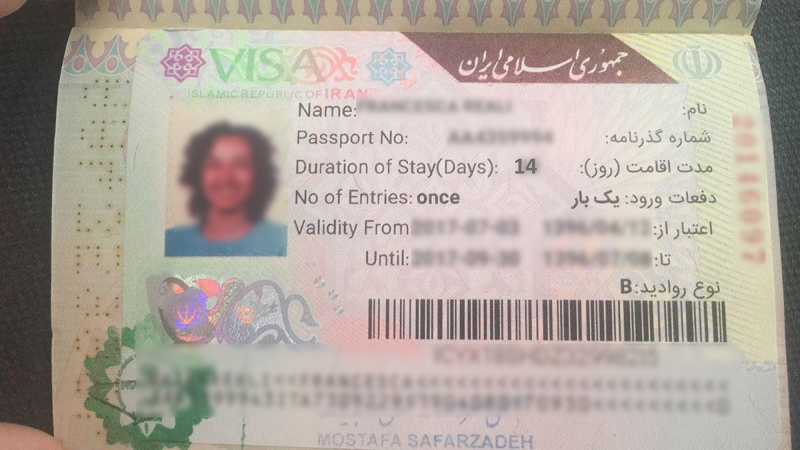
  • Iran Visa on Arrival (VOA) is usually for 14 days of stay in Iran. To extend the duration of stay in Iran, tourist should present him/herself in Police Office of Foreign affairs.


  1. How to get Visa on Arrival (VOA) for American Passport holders?

Americans, US citizen should have their visa stamped before their entry to Iran. Click here for tips about Iran visa for Americans, Canadians and British passport holders.

  1. Is it possible to get Iran visa on arrival for Indian passport holders?

Tourists with Indian citizenship should get Iran visa before entry and arrival to Iran. Having the visa at the airport (VOA) is not possible for Indian nationalities.


Stay on Safe Side!

It’s possible to get Iran visa on arrival and have Iran tourist visa at the airport, but Friendly Iran Visa Advisors suggest you have Iran visa tracking code for a primary approval of your entry and then stamp your Iran visa at the airport.

Free Iran Visa Code with FriendlyIran Tour Operators! Save 45 Euro!

Iran visa service on our Iran tour packages is totally free.

Celebrating Yalda Night

Celebrating Yalda Night

Celebrations in every nation and country may hold for families to gather together, youngsters sit side by side of their elders, and experiencing happy moments and memories. Theses things remind us how majestic nature is and how merciful God has been toward us.

Yalda Night is an Iranian ancient ceremony which is considered as the last night of fall and the first night of winter. This night equals the first night of winter for those who live in the northern part of earth. From this night the length of days increase while nights become shorter than previous nights in fall. Ancient Iranians celebrated this night since they believed that from that night on the lord’s light spread over the earth much more than before. This type of thanksgiving celebration has survived among Iranians to the contemporary era.

Families used to gather at Yalda night in order to move from the lengthiest night to the light of the next day. They wanted to share their happiness with each other. Yalda contains several beautiful traditions each one of them is designed for a reason. It would be great if every body follows these traditions in its best way. Nowadays People set a beautiful table full of delicious foods, fruits and nuts, Meanwhile, in the past people used to sit aroundΒ Korsi at Yalda nights.

Korsi: Korsi is a heating utensil which gives Iranian people a feeling of nostalgia. Korsi is made up of a sort table under which a bowel filled with hot coal is situated. People used to spread a quilt over the table to keep the heat under it. Iranian families used to spend their winter nights sitting beside Korsi.


For Yalda night, people provide so many different foods for their spread. Every province in Iran may have its own specific foods, but what are common among all Iranians are watermelon, pomegranate, special nuts like dry fruits that people used to make them but nowadays you can buy it from different stores. These dry fruits and nuts are figs, raisins, walnuts, almonds, pistachio, hazelnut, apricots and so on. Eating any of these nuts means something special. For example seeds are the symbols of earning. People believe that if you eat watermelon at this night, you will never catch cold in the cold seasons.

Among other traditions some highlights are,Β elders who tell stories to the youngsters of the family,Β reading Hafez poems and see your Fal. Hafez is a famous Persian poet. We believe that if they pray first and then open Hafez Divan, he’ll tell you about the future and what you have in your mind.Β 

Β 

Β   
 

Top 20 Motives to Visit Iran (4)

16. Ta’rof!

As we talked about it at the first step, being Friendly is the most amazing feature of travelling to Iran. Iranians always treat their guest in the best possible way. Taarof is a unique Persian culture makes you feel not a stranger at all, although it may cause some cultural misunderstanding ?…It can’t be described in words, so Befarmaeed az nazdik bebinid…


17. Alamut

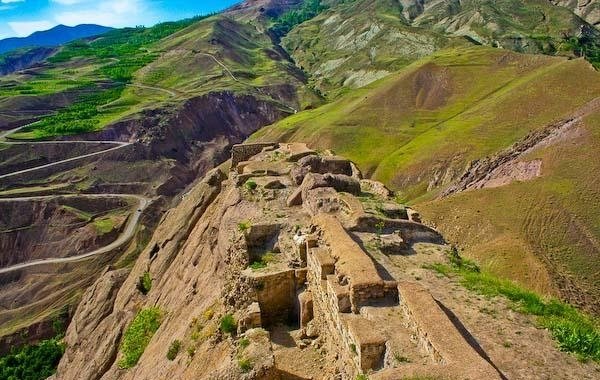
The fabled Alamut Valley offers a tempting invitation to hike, enjoy, explore and reflect among the fabled Castles of the Assassins. More than 50 fortresses that were once home to the medieval world’s most feared religious cult choose a day hike from Qazvin or more extensive wanderings from Gazor Khan, a full trans-Alborz crossing to the Caspian hinterland, an off-road tour in the heart of over 100-year-old jungles. Either way, this is some of the most rewarding hiking to be found in the Middle East.


18. Shiraz, the city of Literature

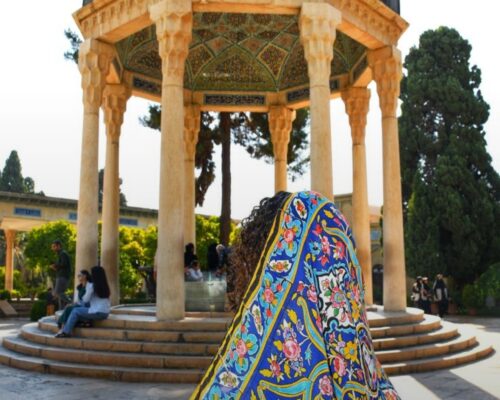
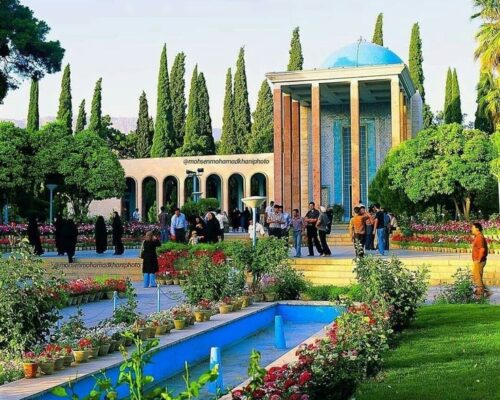
Even in the poorest home you’ll find two books: the Quran and the Divaneh Hafez. It’s appropriate for a country whose most celebrated sons are poets, and where almost every person can quote their favorite millennium-old man of words. In Shiraz, the city of nightingales, roses and gardens, the tombs of Hafez and Sa’di draw pilgrims from around the country. Join them as they linger over tea, reciting the works of their heroes, playing traditional Persian instruments and find out your answers among Hafiz Fals…


[justified_image_grid ids=”12140,12141,12137,12136″]


19. Cheetah

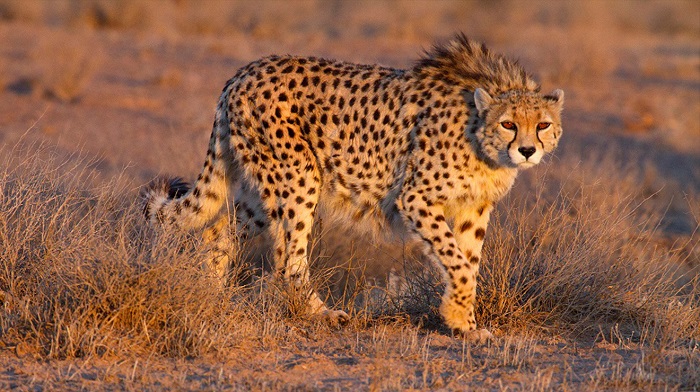
You may wonder “Are there cheetahs in Iran??”…the answer is YES, although…

Iran is trying to save one of the world’s critically endangered species, the Asiatic cheetah. The Iranian cheetah, one of the fastest animals on earth, ranged long time ago from the Red Sea to India, nowadays its numbers shrunk to the level that it is hanging on by a thin thread. The survivors in Iran are estimated from 50 to 70 animals, mostly in the east part of the country.


20. Zoroastrian Fire Temples

Iran is an Islamic Republic, but varieties of religious sites amaze everyone. It’s Zoroastrian sites have an otherworldly charm. Chak Chak, out in a deliciously remote location in the Yazd hinterland, has a superb fire temple with a stunning brass door, even more stunning views, and an air of ritual, ancient and deep. This was the Zoroastrian heartland and remains its most significant pilgrimage site. It’s difficult to come here and not imagine yourself in the days before Islam arrived in Iran. There are other fire temples in Kerman and Yazd.


[justified_image_grid ids=”12135,12133,12132″]

Top 20 Motives to visit Iran (3)

11. Where is modern day Susa?

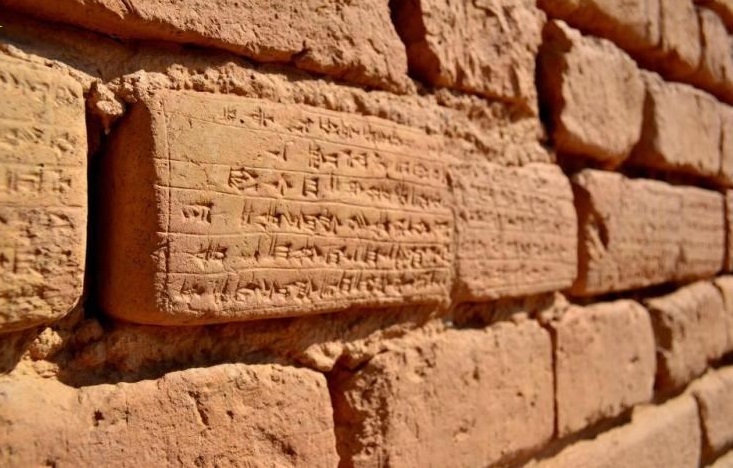
Even if you don’t normally seek out ancient ruins, these three World Heritage sites will make you reconsider. The great bulk and fascinating back story make the Choqa Zanbil Ziggurat, which dates back a mere 34 centuries, one of the most impressive historical sites in a region full of them. Now excavated, some of the bricks look as if they came out of the kill last week and theΒ Tomb of Danial with its unique architecture. Susa or Shush is a fabulous ruin of a place with a castle, acropolis and palace remnants, while Shushtar impressively rounds things out. The ancient watermills of Shooshtar date back to Darius the Great, is a masterpiece of architecture.


12. Tehran Art Scene

Tehran’s excellent museums and palaces provide great insights into Iran’s past. However, to gain a handle on its present, don’t miss the city’s range of hip cafes and contemporary art galleries. These provide an entree into a side of modern Iranian life; they are creative, challenging and liberal, you seldom hear much about in the media. Even government sponsored institutions such as the Iran Holy Defence Museum and Qsar Garden Museum make inventive use of contemporary art. There are many galleries in Tehran which present contemporary art such as Aran art, Elahe Gallery, Homa art gallery, Aun gallery, Etemad gallery, Seyhoun art gallery, Silk Road art gallery, and Sien gallery.


[justified_image_grid ids=”12080,12086,12083,12084″]


13. Islamic Bazaar

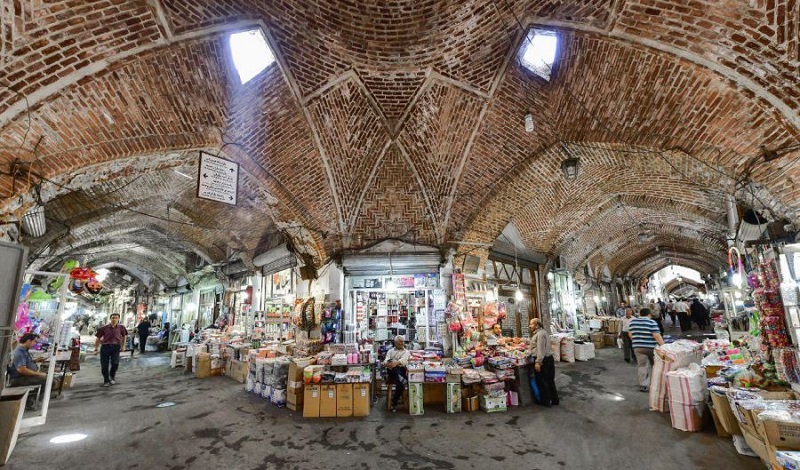
In the age of the superstore, most Iranians rely on these mazes of covered lanes, madrasehs and caravanserais for much of their shopping. Tehran, Esfahan, Shiraz, Kerman, Qazvin, Lar and Kashan all have atmospheric bazaars where you can browse beneath domed ceilings, dodge motorcycles and stop in teahouses for a brew. Perhaps the greatest is the World Heritage listed, Tabriz Bazaar, the world’s largest covered bazaar and once among the most important trading centers on the Silk Road.


14. UNESCO world heritage city of Iran, YAZD

Few places have adapted to their environment as well as the desert city of Yazd. It’s a gem of winding lanes, blue tiled domes, soaring minarets, bazaars, and Court yard homes topped by badgers (windrowers) and watered by Qanats (underground water channels). Several of these homes have been restored and converted into evocative traditional hotels. Many travelers declare Yazd to be their favorite city in Iran, and it’s not difficult to see why, combining as it does a whiff of magic on the cusp of the desert. Summer places not far from this desert area are the unexpected combination you can’t miss.


[justified_image_grid ids=”12088,12087,12082″]


15. Western Iran

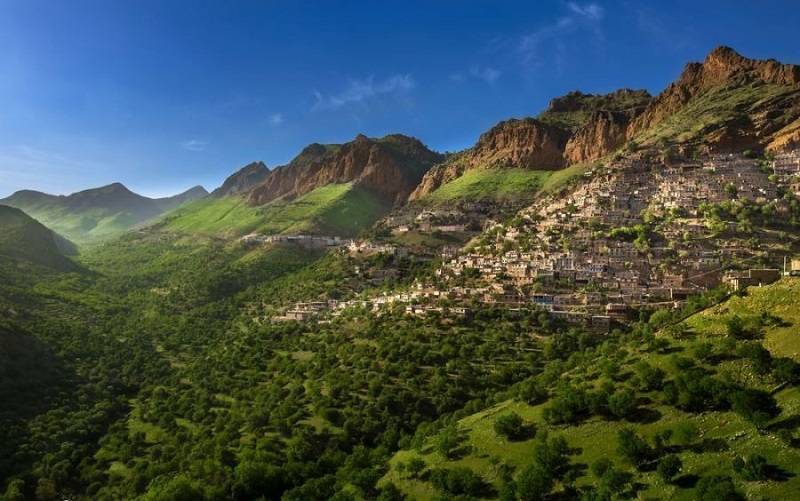
With the slowdown in overland travel, few make it out west, but that’s just the way we like it. Track down UNESCO World Heritage, listed Armenian churches. Follow the route through Howraman on your way between Marivan and Paveh, named Thousand Masuleh for owning many villages the same as Masuleh. Explore the Aras Valley or spend time getting to know the Kurds around Howraman, the mountain villages around Paveh, the Azeris in the northwest, the Gilan on the Caspian Coast, the Arabs of Khuzestan and so many more unique attractions. Put them together and Western Iran is worth building your entire trip around.


Top 20 Motives to Visit Iran (2)

6. Yummy Trip

Iranian food is one delicious surprise after another. Once you’ve tried several varieties of kabab, khoresht (stew), ash (soup), and flatbread, ask for Fesenjun (chicken in walnut and pomegranate sauce) or anything with Bademjan (eggplant), or try Gilan cuisine with its predominantly sour flavors, this city is the only registered UNESCO creative city of food under the name of Iran. Then you can try the Shirini (local sweets), … As exquisite as so many Iranian flavors are, it’s the buzz that surrounds eating, the primacy of food in so many social encounters that makes it truly one of life’s great pleasures.

7. Esfahan, city of the blue-tiled dome

There are moments in travel that will long stay with you, and your first Sight of Esfahan’s majestic Naqsh-e Jahan (Imam) Square is one of them. This Square is home to arguably the most majestic collection of buildings in the Islamic World: the perfectly proportioned blue-tiled dome of the Masjed-e Shah, the supremely elegant Masjed-e Sheikh Lotfollah, and the indulgent and lavishly decorated Ali Qapu Palace. Far from being a static architectural attraction, the square and the nearby traditional tea houses overlooking the river throng with life. The Qeysarieh bazaar which is surrounded by the square won’t let you feel the time passing!

8. Imam Reza Holy shrine

Iran is an Islamic Republic country and while most travelers find Islam is not nearly as all-pervasive as they had expected, the Shiite faith remains an important part of Iranian life. It is at its most obvious in the passionate devotion seen at monuments such as the huge Haram-e Razavi in Mashhad. The main draw here is the Holy Shrine of Imam Reza, the only Shiite imam buried in Iran. The passion and warmth you’ll encounter here lend a powerful sense of Islam as a force for good in the world. The city of Mashad is one of the important stops along the Silk Road.

9. Persian carpets

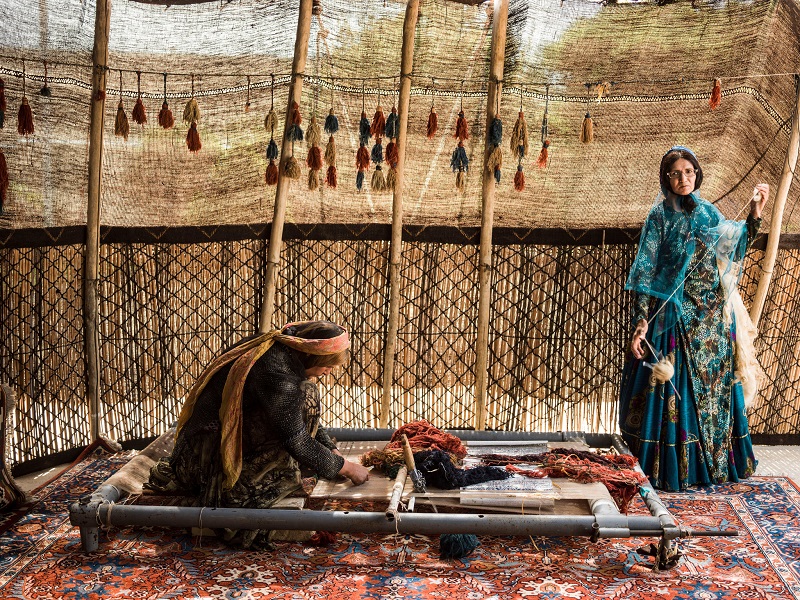
The Persian carpet is best known and appreciated among all hand-knotted carpets over the world. In the East, the carpet has particularly dated back to the 5th or 6th centuries; later the knotted carpet has been introduced in Persia by the Seljuks in the 11th century. The oldest carpet we received is known as Pazyryk Carpet, from approximately 500 BC. The art of Persian rug reached the highest peaks during the Safavid dynasty or the beginning of the 17th century. We classify the Persian carpets according to the knotting time: ancient, old, new, and modern Persian carpets; they usually take the name from the city or knotting area so we can divide them out of the areas of origin.

10. Persepolis

The artistic harmony of the monumental staircases, imposing gateways, and exquisite reliefs leaves you in little doubt that in its prime, Persepolis was at the center of the known world. These days it’s Iran’s premier ancient city. Built by kings Darius and Xerxes as the ceremonial capital of the Achaemenid Empire, located not far from the great city of Shiraz, is one of the attractions you need to add to your tour like it or not J. And do not miss the monolithic tomb that sat nearby Necropolis or Naqsh-e Rostam.

To be continued…

Top 20 Motives to Visit Iran (1)

[vc_row][vc_column][vc_column_text]

1. Friendly People

The first impression after entering the country is “Do they know me?!”

In any competition for the title of the world’s friendliest people, IraniansΒ would be definite finalists.

It’s the people that leave the most lasting impressions from any journey to Iran,Β their warmth and their hospitality, their willingness to set aside enmities between countries and welcome you with open arms and doors.

Whoever you meet, you will regularly bask what you think of Iran, told β€˜You are our guest’ and brought tea, local sweets, and even food. Meeting Iranians is, quite simply, the best experience in Iran.Β 


Β 2. Desert

Three different types of deserts including various attractions have made Iran a popular destination for desert lovers. The welcome is rarely warmer than in the vast, empty silence of Iran’s two great deserts. Garmeh is the oasis village of your dreams, with a crumbling castle, swaying date palms, and the sound of spring water. It’s the sort of place you come for one night and stay more. Nearby Farahzad and tiny Toudeshk Cho, between Esfahan and Na’in, also offer memorable desert-style family homestays; think beds on the floor, basic bathrooms, fresh, delicious home-cooked food, and endless horizons just outside your door.


3. Not only sand dunes

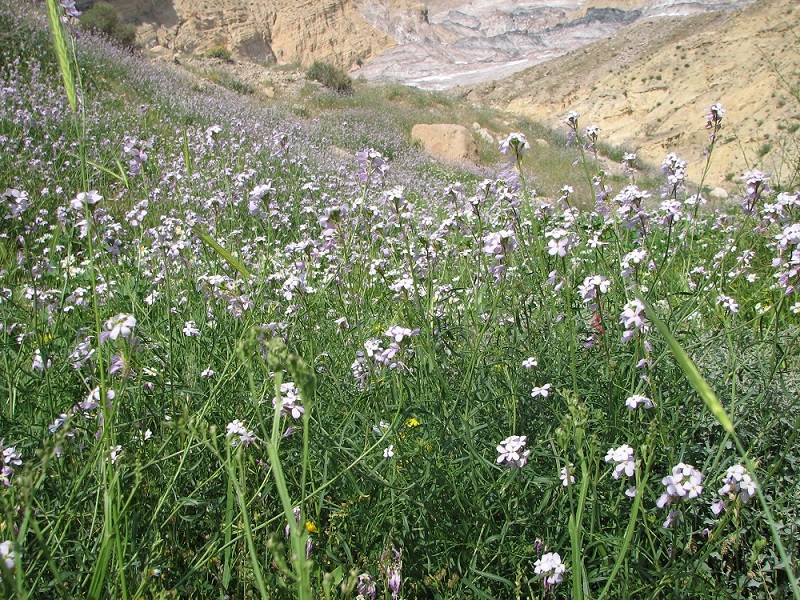
In addition to big desert areas in the land of Persia, mountain chains of North and West are the big reasons for a completely different nature in the western and northern parts. Mount. Alborz is located in the north of Iran and Zagros in the west.

You can enjoy unique nature such as mountain parks, Nomadic life,Β mountain villages, 100 years old jungles, and much moreΒ attractions.


4. Nomads of the Zagros

About two million Iranians from several different ethnic groups still live a nomadic existence, traveling with their goats in spring and autumn in search of pasture. Qashqa’i and Bakhtiyari nomads spend the summer months in the Zagros Mountains, before heading down to the coast for the winter. You can get a taste of nomad life on a day trip from Shiraz to Sepidan or Khan Zenyan.


5. Skiing

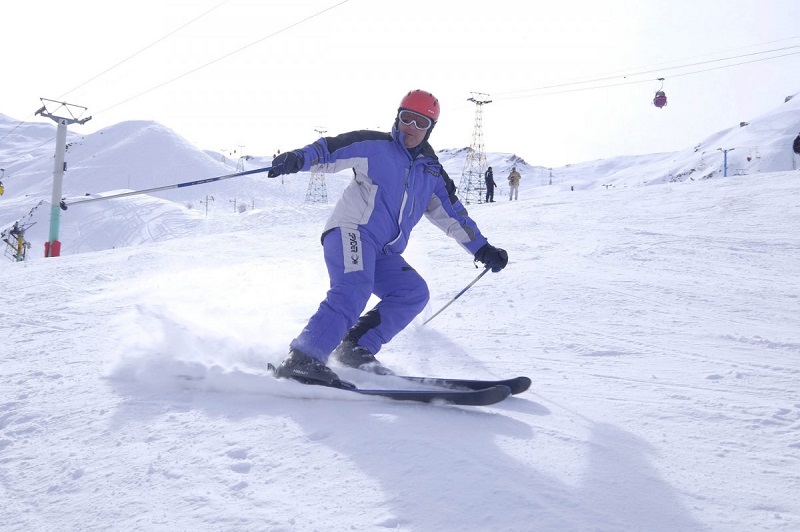
Think Iran and skiing is hardly the first thing that springs to mind. But Iran has more than 20 ski fields and most of the action is conveniently concentrated around Tehran. The Dizin and Shemshak resorts are the pick, with steep downhills and plenty of untracked Powder to keep skiers of all levels interested. Chalets and ski passes are inexpensive compared with Western countries and the slopes are relatively liberal, beloved as they are by Tehran’s upper-middle class. Pooladkaf ski resort is another one located in the south of the country.


To be continued…

[/vc_column_text][/vc_column][/vc_row]

Jashk Salt DomeΒ 

Β an Amazing Geological Attractions in Iran

Are you interested in adding off-beaten attractions to your Iran tour?!

Salt dome or as Iranian call it Kuh-e Namak, is one of the magnificent natural beauties all over the world. Jashk salt dome also known as Dashti salt dome is the biggest sample in Iran and also middle east. This colorful mountain covers an area of about 3660 hectares on the Southern slope of Zagros Mountains, in Bushehr province.

You will be surprised by the variety of attractions here, salt waterfalls and salt springs, making different salty shapes in the water such as Cauliflowers, and salt caves full of stunning salt crystals. Different colors, red, brown, yellow, black and white, has made this attraction so matchless among the other 114 salt domes in south of Iran.

[justified_image_grid ids=11348,11351,11344,11347]

Salt glaciers are another majestic treasure of the area. The name glacier is showing the similarity of salt and snow. You never can recognize a salt dome from a snow-covered mountain in the distance. The adorable points about this similarity is the green land full of flowers which exists some steps away from the glaciers ?

Best time to visit the waterfalls is from mid Spring till autumn and as this phenomenon is located near Persian Gulf, you will have the chance to explore the southern ports and enjoy different water sports such as diving.


Top 5 Traditional Hotels of Middle East in Iran 2018

Each year Trip advisor, the world famous tourism magazine, announces BestΒ Middle East B&Bs and Inns.

In 2017, Iranian House,Β Β Saraye Ameriha,Β Β Manouchehri house and Ehsan house were 4 suggested Traditional and Historical House in Kashan among 25 Best Bed and Breakfast hotels and inns. They were also Top accommodation in Kashan based on tourist reviews in 2017.

In 2018, Tripadvisor again listed best inns and B&B hotels in Middle East. In the 25 selected Inns, Iran got 5 bests, this time in different cities and regions,eg; Qeshm Island, Kashan, Varzaneh desert and Yazd.


Close Look at Iran hotels and traditional house photos[/vc_column_text][vc_empty_space][/vc_column][/vc_row][vc_row][vc_column][vc_column_text]

1. Assad House in Qeshm, Iran

Locating in a good location in Qeshm island, by overnighting in Assad B&B homestay you can enjoy walking to the sea and visit the Island with him.

Amenities and facilities:

  1. Free Parking
  2. Free High-Speed Internet (WiFi)
  3. Breakfast included
  4. Airport Transportation

Mesir Bashgah Kelato | Bandar-e-Doulab, Qeshm, Iran


2. Iranian House

Iranian historical house is actually a 4* B&B Hotel, it’s very well located and stylish.Β 

Β Hotel Amenities and Facilities:

  1. Free Internet
  2. Breakfast included
  3. Airport Transportation
  4. Concierge
  5. Laundry Service
  6. Multilingual Staff

Address; No 8, Fifth Bastan Alley , Alavi St., Fazel Naraqi AveΒ |Β Kamal-ul-molk Sq,Β Kashan 87134,Β Iran


3. Saraye Ameriha Boutique Hotel

A highlight historical house, with a very splendid area, architecture and great service.

Amenities and Facilities:

  1. Free High-Speed Internet (WiFi)
  2. Restaurant
  3. Breakfast included
  4. Air Conditioning
  5. Banquet Room
  6. Breakfast Available
  7. Concierge
  8. Conference Facilities
  9. Dry Cleaning
  10. Meeting Rooms
  11. Minibar
  12. Multilingual Staff
  13. Non-Smoking Hotel
  14. Refrigerator in room

Address:Β Alavi Avenue,Β Kashan 87134,Β Iran


4. Chapaker Guest House

This Inn is located in Nain city, between Esfahan and Yazd. One of the best choices for those who love Varzaneh Sandy desert.
Amenities and Facilities
  1. Free Parking
  2. Free High-Speed Internet (WiFi)
  3. Breakfast included
  4. Breakfast Available
  5. Non-Smoking Hotel

Address:Β Beheshti Street,Β Varzaneh 8145657333,Β Iran


5. Jungle Hotel

In the old part of the city, in Yazd. A cosy new built house in an oldΒ style.

Amenities and Facilities:

  1. Free High-Speed Internet (WiFi)
  2. Breakfast included
  3. Free Parking
  4. Air Conditioning
  5. Airport Transportation
  6. Breakfast Available
  7. Laundry Service
  8. Non-Smoking Hotel
  9. Refrigerator in room

Address:Β Emam Ave FAHADAN STREETΒ |Β Fahadan, Front of coin museum,Β Yazd 8919954177,Β Iran

Iranian hotels and traditional houses Best Picture and photos

Top 10 Things to Do in Isfahan

[vc_row][vc_column][vc_column_text]

Isfahan one of the best and most beautiful and tidiest cities of Iran used to be the capital of Persia in glory days of 17th century. It is called β€œhalf-of-the-world” by many people due to its uniqueness and grandeur. It is a live museum of artisans and the handicrafts with its historic bazaar, attractive bridges, and adorned mosques. The city of blue domes is the home land of Muslims, Jews and Christians who live peacefully together. As Jean Chardin, a 17th-century French traveler, writes: β€œThe greatest and the most beautiful town in the whole of Orient” and β€œwas expressly made for the delights of love”.

Here are the most valuable attractions in tourists’ eyes:[/vc_column_text][vc_empty_space height=”12px”][/vc_column][/vc_row][vc_row][vc_column][vc_column_text]

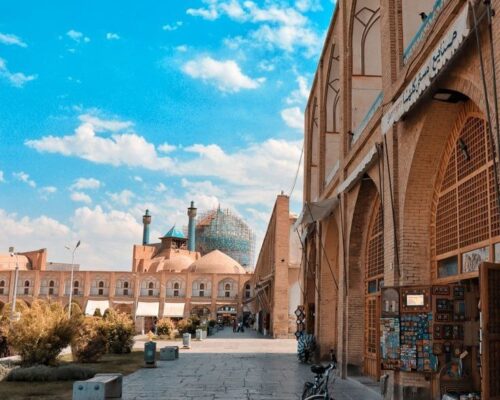
  1. Naqsh-e Jahan Square: Known also as Imam Square, is the masterpiece of Safavid era and one of the UNESCO’s World Heritage Sites. The royal square was the place where Shah and his people met. It is surrounded by four highlights including Imam Mosque, Sheikh Lotfolah Mosque, Alighapoo edifice and Bazaar.

[/vc_column_text][vc_masonry_media_grid element_width=”3″ grid_id=”vc_gid:1534842239753-e582bce3-4955-10″ include=”5482,5583,6846,6844,8888,8890,8891,8892″][/vc_column][/vc_row][vc_row][vc_column][vc_column_text]

Imam/Shah Mosque: Designed with blue-tiled mosaic presents perfectly proportioned architecture of Safavid era and creates a marvelous view to your eyes. The majesty of the architecture of this mosque cannot be described in words; thus, you must go there to pay a visit in person.

[/vc_column_text][vc_empty_space height=”10px”][/vc_column][/vc_row][vc_row][vc_column][vc_column_text]

Ali Qapu Palace: A huge portal that is opposite to Sheikh Lotfollah Mosque. Shah Abbas used to celebrate Nowrooz (Iranian New Year) in this fabulous edifice. 18 columns of this monumental palace are decorated with mirrors and the ceiling is covered with great paintings. A splendid music hall is in the sixth floor with deep circular niches in the walls for music echoing. Shah used to sit in the edifice terrace and enjoy watching polo matches.

[/vc_column_text][/vc_column][/vc_row][vc_row][vc_column][vc_column_text]

Sheikh Lotfollah Mosque: A valuable monument dominating the boundary of the Naqshe Jahan Square which was the first one among the four constructed edifices around the Square. Although, in comparison with Imam Mosque, Sheikh Lotf Allah Mosque is very simple in design, but it has an exceedingly complex decoration both inside and outside. The exterior of its single dome is richly ornamented with exquisitely made and beautiful tiles.

[/vc_column_text][vc_masonry_media_grid element_width=”2″ grid_id=”vc_gid:1534842239825-26897407-8be2-3″ include=”8894,8895,6838,6839,8896″][vc_empty_space height=”10px”][/vc_column][/vc_row][vc_row][vc_column][vc_column_text]

  1. Isfahan Bazaar: A historical market in Isfahan and one of the oldest and largest bazaars in the Middle East. The bazaar is a two-kilometer street connecting Isfahan’s old city to the new part. Every line of the bazaar is allocated to certain types of goods, such as colorful Iranian carpets, hand woven rugs, shoes, spices, gold, silver and handicrafts such as Moarraq, a sort of manual wood working, Khatam, the wooden articles with fine pieces of wood, bone and metal precisely cut in geometrical shapes. There are also several workshops where you can see the handicrafts making process.

[/vc_column_text][vc_masonry_media_grid element_width=”2″ grid_id=”vc_gid:1534842239868-b93ed1ed-b87d-3″ include=”8899,8900,8901,8902″][vc_empty_space height=”10px”][/vc_column][/vc_row][vc_row][vc_column][vc_column_text]

  1. Jolfa square: The Armenian square of Jolfa in Isfahan is a place where Christians live peacefully and do their religious rites. Their ancienter migrated from Jolfa town in the north of Iran during Safavid era. There are Armenian churches, an old cemetery and music museum in this fashionable area. In the afternoons and evenings many visitors are strolling the quarter and enjoying Armenian coffee in a liberal atmosphere.

Β Vank Cathedral: Another marvelous piece of art with splendid architecture is Vank Cathedral in the Armenian square. Its architecture is a combination of 17thΒ century Safavid style with lofty arches and a dome with Islamic design. The biblical story is depicted by the paintings drawn on the brick dome. Its museum is the house of valuable collections gathered from all the Armenian world such as Safavid costumes, tapestries, European paintings, embroideries and a small seven-gram bible believed to be the smallest written text in seven languages.

Music Museum: There are more than 300 Persian instruments including Kamancheh,Β Tar, Ney, majestic harp and nomadic camel bells. It is not just a museum full of musical instruments; visitors have access to the less precious pieces and they can even try to play. They also enjoy masters’ performance of traditional Persian love songs.

[/vc_column_text][vc_masonry_media_grid element_width=”2″ grid_id=”vc_gid:1534842239891-6a1d9a31-942d-0″ include=”5665,7917,8927,8928,8929,8930″][vc_empty_space height=”10px”][/vc_column][/vc_row][vc_row][vc_column][vc_column_text]

  1. Menar-e Jonban (Shaking Minarets): It is a historical monument that was constructed during the Ilkhanid era. The edifice was decorated with dark blue tiles and bricks. There is a marvelous peculiarity about this building. At the summit of one of the minarets, if someone hold the minaret and shake it by hands, the other minaret on the opposite side will surprisingly shake, too. This instance of unprecedented coupled vacillation is observable from the ground.

[/vc_column_text][/vc_column][/vc_row][vc_row][vc_column][vc_column_text]

  1. The City of Bridges: One of the remarkable attractions in Isfahan is its bridges. Five old bridges have constructed cross the seasonal river of Zayandehrood. They date from Safavid era and even earlier.

Si-o-Seh Pol: This ancient bridgeΒ is probably Isfahan’s most famous bridge. It is made up of 33 arches in a row on the river. During the Safavid era the ceremonial feasts of Abrizan (throwing water) of the Armenians were held beside this bridge. It is regarded as one of the masterpieces of Iran’s and the whole world’s architecture and bridge construction.

Pole Khaju (Khaju Bridge): Β Due to the pleasing construction idea of the bridge, it becomes one of the famous bridges of Iran. It is built in Safavid era. The primary function of this bridge was abode for public meeting or as a tea-house.

Pole Marnan (Marnan Bridge): The exact date of the bridge construction is unknown but there are signs in the bridge foundation that date back to Sassanid Dynasty. The Bridge used to be the important western bridge in Isfahan during the Safavid era.

Pole Shahrestan (Shahrestan Bridge): The pillars are made of cement and ballast. The foundation of the bridge is Sassanid and Achaemenid and the buildings on the bridge have influenced by Islamic architecture.

Pole Choobi (Choobi Bridge): Another famous bridge of Isfahan, constructed by Shah Abbas II during Safavid era. it was built in order to irrigate Safavid royal gardens close by.

[/vc_column_text][vc_masonry_media_grid element_width=”3″ grid_id=”vc_gid:1534842239934-be851ce4-3b17-0″ include=”8934,8935,5588,8936″][vc_empty_space height=”10px”][vc_empty_space height=”10px”][/vc_column][/vc_row][vc_row][vc_column][vc_column_text]

  1. Isfahani art of cuisine: The popular Iranian cuisine is ancient, rich and indeed delicious. It is so various due to the extent of the country and the climate diversity. The traditional restaurants in Isfahan are dedicated to specific traditional foods of the area, do not miss them.

Beryani, the real taste of baked meat: This is the most famous traditional food goes back to about 400 years ago, served in unique restaurants of Isfahan. It is the burger shape mixture of lamb, saffron and some herbs served in a traditional bread.

Gaz: Gaz is the traditional name of Persian nougat which is a kind of candy originated from the city of Isfahan and Boldaji. It is decorated with small pieces of pistachio or almond to give it the special taste of nuts. You can also shop this tasty and sweet candy and take it as souvenir to your country and eat it along with a cup of saffron tea.

[/vc_column_text][vc_masonry_media_grid element_width=”2″ grid_id=”vc_gid:1534842239955-65438f89-b962-10″ include=”8939,8940,8941,8942,8943″][/vc_column][/vc_row][vc_row][vc_column][vc_empty_space height=”10px”][vc_column_text]

  1. Unique Gardens: This azure city which shines like a piece of diamond in the center of Iran’s plateau is intertwined with lovely gardens to give a new sense of the beauty of urban spaces.Β There is a famous historical avenue constructed during SafavidΒ dynasty named Chahar BaghΒ (Four Gardens), this 6-km lovely street connects the north of Isfahan to the southern parts.

Chehel Sotoun: A pavilion with the Achaemenid-inspired style with an elegant terrace in the middle of a garden at the end of a long pool, a masterpiece of Safavid era and declared as a UNESCO heritage garden. The important meetings and feasts were held in this palace during Safavid dynasty. β€œChehel Sotoun” means forty pillars that is the number of twenty wooden pillars plus their reflections in the long pool in front of the palace. Moreover, it contains many eye-catchin paintings on ceramic.

Hasht-Behesht: It is a magnificent palace in a paradise like garden belonging to the Safavid era. The name of the pavilion has been derived from the β€œHashti” meaning entrance or gate and Hasht Behesht means the gate to the Heaven. The decorations of the edifice and the beautiful and majestic garden around the palace is so artistic that has been admired by many of its visitors.

Birds Garden: For sure it is one of the world’s most beautiful birds’ gardens. This 17,000 square meter garden is filled with nearly 5,000 animals of 130 species. Each section of this recreational, scientific and research center welcomes the interested lovers of nature and specifically birds.

Flowers Garden: The garden is comprised of different kinds of gardens including the Rose garden, edible and medical herbs garden, the Chrysanthemum Garden, the Iris Flower Garden, a greenhouse and an area full of wonderful fountains. The whole garden’s surface is covered with grass and seasonal flowers and ornamental small trees.

[/vc_column_text][/vc_column][/vc_row][vc_row][vc_column][vc_masonry_media_grid element_width=”2″ grid_id=”vc_gid:1534842239989-4a7a8a07-af71-7″ include=”8978,8979,8982,8983,8984″][vc_empty_space height=”10px”][/vc_column][/vc_row][vc_row][vc_column][vc_column_text]

  1. Aquarium: It is a large aquarium with a duck pond and a variety of aquatic life in sweet and salty water including Japanese carp and sharks. Its tunnel is the largest of its kind in the Middle East and is built in an underground area with about six-meter height.

[/vc_column_text][vc_masonry_media_grid element_width=”2″ grid_id=”vc_gid:1534842240018-5959f859-3e0c-5″][/vc_column][/vc_row][vc_row][vc_column][vc_column_text]

  1. Nain: It is a town in 140km east of Esfahan. The most important monuments of Nain are Jame Mosque, one of the oldest mosques in Iran, the splendid Narenj Fortress, the traditional house of Pirnia, the traditional Bazaar, Qanat and a Zurkhaneh. The town is also famous for its high-quality carpets.

[/vc_column_text][vc_masonry_media_grid element_width=”2″ grid_id=”vc_gid:1534842240026-9050a03b-3661-4″][/vc_column][/vc_row][vc_row][vc_column][vc_column_text]

  1. Varzaneh desert: ItΒ is located 105km southeast of Isfahan. Varzaneh is popular for its spectacular desert and safety. Due to the short distance from Isfahan, it is rated as one of the most accessible deserts in Iran. Varzaneh, is unique in the local women’s costumes. They wear whiteΒ chadors, while the black one is common in Iran.

[/vc_column_text][vc_masonry_media_grid element_width=”2″ grid_id=”vc_gid:1534842240036-1077d2e7-1bb1-1″][/vc_column][/vc_row]


Top 10 Things to Do in Yazd

[vc_row][vc_column][vc_column_text]

Yazd, the city of wind-catchers (Shahr-e-Baadgirha) and the ancient location on the Silk Road, emerging like a phoenix from the desert in the center of Iran. Due to its neighborhood with the deserts, Yezd has taken a unique adorable architecture. Dating back to the Sassanian period, Yazd is very well known for its Zoroastrian attractions, Qanats, Yakhchals (ice houses), ab-anbars, and many other features such as Persian handicrafts, and its well-known delicious Yazdi confectionery. The province of Yazd is well connected to the rest of the main Iranian cities by planes, buses, and also trains.Β 

Lengthen your stay in Yazd and experience the following attractions and activities inside the city and surroundings.

[/vc_column_text][vc_empty_space height=”10px”][/vc_column][/vc_row][vc_row][vc_column][vc_column_text]

1. The Old Town of Yazd according to UNESCO is the perfect place to see the region’s rich history. This place is where the modern life meets the ancient history when you watch cars and bikes passing the covered narrow alleys of this charming ancient district or standing on the fantastic Rooftops and gazing at the ancient domes and minarets. Most of the old town highlights are within easy walking distance from each other located in the labyrinth of small streets surrounded by the silence of the mud-brick walls with incredible oriental architecture, a combination of Persian and Islamic architecture style. It’s better to visit the old part in groups of at least two people for not getting lost, although you may want to get lost in for a while…

[/vc_column_text][/vc_column][/vc_row][vc_row][vc_column][vc_masonry_media_grid element_width=”3″ grid_id=”vc_gid:1535785456740-b531a3de-c8b9-0″ include=”8829,8830,8831,8837″][/vc_column][/vc_row][vc_row][vc_column][vc_empty_space height=”10px”][vc_column_text]

2. Zoroastrianism Treasures: After Arabs invasion, many Zoroastrians migrated to Yazd. Yazd means God and Zoroastrian religion presents itself in different parts of the city within fabulous attractions such as Towers of silence or Zoroastrians’ CryptΒ which have been the burial place of Zoroastrians according to their religious burial ceremonies in the past. Nowadays they bury their dead people in the graves like Muslims. There is an Ossuary in the middle of the crypt where some bones have been discovered belonging to the corpses. Towers of silence or as local say β€œGur Dakhma” breathes history and It’s got an amazing view over the adobe city.

Another holy Zoroastrian Building surrounded by pine and cypress trees is Atashkade or Fire temple. Beautiful ancient architecture turned this place into one of the main attractions of Yazd. Β People believe that the fire inside this temple hasΒ been burning for more than 1,500 years. Zoroastrians hold special ceremonies near this fire and had to wear white or light-colored clothing to enter the building. Chak Chak or Pir-e Sabz Fire Temple is another pilgrimage site located 70 kilometers from Yazd in the middle of a mountain. There is a legend about this village says that β€œone piece of rock of this cliff open its mouth up and Nikbanu took shelter from the invasion of Arabs”. β€œChak Chak” has an eternal spring, according to the legend, is still crying to commemorate the Princess Nikbanu. Markar Historical Complex helps you to know more about this unique culture, before visiting the above attractions.

[/vc_column_text][/vc_column][/vc_row][vc_row][vc_column][vc_masonry_media_grid element_width=”2″ grid_id=”vc_gid:1535785456830-9255d15e-bd3e-1″ include=”8833,8834,8835,8836,8841″][vc_masonry_media_grid element_width=”2″ grid_id=”vc_gid:1535785456846-9bb09c81-f910-2″ include=”8876,8877,8878,8880,8881″][vc_empty_space height=”10px”][/vc_column][/vc_row][vc_row][vc_column][vc_column_text]

3. Yazd Jameh Mosque, the most beautiful tiled mosque of 12thΒ century with a splendid architecture and the highest minarets in the country. The other attractive point about this mosque is its eye-catching colored tiles of the faΓ§ade; blue, gray and white tiles have elegantly decorated inside the long-arcaded courtyard. You can take marvelously beautiful pictures there when the sun sets. The Jame mosque is located near Yazd traditional bazar where you can go shopping in the beautifully lit, vibrant market and taste Yazdi cakes and sweets.

[/vc_column_text][vc_masonry_media_grid element_width=”2″ grid_id=”vc_gid:1535785456884-c22299a2-c927-3″ include=”8847,8846,8848,8850,8849″][/vc_column][/vc_row][vc_row][vc_column][vc_empty_space height=”10px”][vc_column_text]

4. Amir Chakhmagh SquareΒ is probably the image that travelers have in mind about Yazd, it attracts every passengers’ especially at night when it is lit up and decorated. This three-storey faΓ§ade is a highlight of Iranian architecture dates back to 19th century. There is also a spiral staircase that provides the most beautiful view of the city. Amirchakhmaq is a complex consist of a mosque, a caravanserai, a bathhouse, a cold-water well and a tekyeh. Beneath the complex, there is a bazaar where you can also eat a unique Persian food named Jigar Kebab (grilled liver). There is also a huge wooden palm tree used for Ashura commemorations.

[/vc_column_text][vc_masonry_media_grid element_width=”3″ grid_id=”vc_gid:1535785456910-8b693735-1901-10″ include=”8852,8853,8854″][/vc_column][/vc_row][vc_row][vc_column][vc_empty_space height=”10px”][vc_column_text]

5. Dowlat-Abad Garden, a UNESCO World Heritage Site and one of the oldest gardens of the region owns a colossal wind-catcher, the tallest wind tower in the country which is visibleΒ from meters away. This traditional air-conditioning system invented for desert areas is the essential elements at the residential structures. The garden area covers as big as 70000 square meters and the founder of the pavilion had built a Qanat of 65 kilometers to bring water from Mehriz city.

[/vc_column_text][vc_masonry_media_grid element_width=”2″ grid_id=”vc_gid:1535785456930-5d6db028-782f-3″ include=”8858,8859,8860″][vc_empty_space height=”10px”][/vc_column][/vc_row][vc_row][vc_column][vc_column_text]

6. Yazd Specific Handicrafts and Sweets, the best souvenirs you can bring back home. Termeh is a specialty cloth woven by hand with silk, wool and fiber. It may take the forms of fabric, sheets, panels and other shapes and used to make clothes for weddings, table cloths and floor spread sheets. Around Yazd Grand Bazaar, you will see lots of shops selling Termeh.

Sweets such as Sohan, Pashmak, Baklava and Qottab are famous sweets of the city that many visitors, Iranians or foreigners, are really interested. Haj Kalifeh Rahbar and Yazd traditional sweet (shirini sonati) are two most famous confectioneries in the city with different branches.

[/vc_column_text][vc_masonry_media_grid element_width=”3″ grid_id=”vc_gid:1535785456959-91b552b0-715b-2″ include=”8869,8870,8871,8872″][vc_empty_space height=”10px”][/vc_column][/vc_row][vc_row][vc_column][vc_column_text]

7. Surrounding Deserts and villages are great choices if you are a desert lover. Within 15km drive from Yazd, desert landscape is a great escape from the city noise and watching the sun set across the sand dunes would be a great ending. Here are some of the specific features and attractions close to Yazd and easily accessible.

Kharanaq village located About an hour from Yazd has a great view of an ancient village and its Jame mosque dates back to the first century AH. Fahraj is another highlight near Yazd with a lovely desert inn. Bafgh Desert is located within 2 hours drive from Yazd and is a big sand desert.Β Hotel Alamdar is a great option if you would like to stay the night in Bafgh.

[/vc_column_text][vc_masonry_media_grid element_width=”2″ grid_id=”vc_gid:1535785456990-608b9a58-1622-1″][/vc_column][/vc_row][vc_row][vc_column][vc_column_text]

8. Zurkhaneh, the sacred place for Persian heroic sport, is going to be a unique experience for foreigners to see athletes using wooden clubs and doing specific exercises. before entering, practitioners kneel and bless the ground. The Zoorkhaneh exercises are accompanied by rhythmic drumming and spiritual songs. Saheb Al Zaman Zurkhaneh or Panj Badgiri is a great option for visitors to experience this Persian traditional sport in a short visit, it is located in Amir Chakhmagh Square and was built on a 500-year-old water reservoir.

[/vc_column_text][vc_masonry_media_grid element_width=”2″ grid_id=”vc_gid:1535785456997-34a2944b-a824-5″][/vc_column][/vc_row][vc_row][vc_column][vc_column_text]

9. Shirkooh, located in the south part of Yazd, is one of the most famous summits of Iran central mountain chains. One-day ascent to the peak of Mount. Shirkooh (4000 meters) is possible in all seasons, although it’s going to be hard for inexperienced ones. For experts 6 to 7 hours is enough to reach the top and early spring is the best time to plan your Shirkuh mountaineering.Β Deh-bala is the village you need to start your hiking from, there is a hotel inside the village, Mahtab Hotel, a great option for travelers who are eager to stay the night there.

[/vc_column_text][vc_masonry_media_grid element_width=”2″ grid_id=”vc_gid:1535785457006-291e68c9-8b35-5″][/vc_column][/vc_row][vc_row][vc_column][vc_column_text]

10. Henna Grinding is one of the ancient professions of Yazd related to the Iranians who did business with merchants from different neighboring countries such as Persian Gulf countries and India. Henna or Hina, a dye prepared from the plant Lawsonia inermis, is used to color hair, skin, fingernails, and etc.Β A few henna mills are located near the Yazd Mirror Museum where you can pay a visit.

[/vc_column_text][vc_masonry_media_grid element_width=”2″ grid_id=”vc_gid:1535785457011-f0f6f786-e030-2″][/vc_column][/vc_row]

The Persian Qanat

[vc_row][vc_column][vc_column_text]

What is Persian Qanat or Kariz?

Persian underground banks or Qanats are one of the fascinating water extraction and shifting system which has made living in the arid regions possible and added a great value to the Iranian ancient culture.

Qanat is the Arabic term of this system, its Persian name is Kariz or Kahriz, meaning the water channel. About two thousand years B.C. Qanats were invented by brilliant Iranians to pull up the water from underground aquifers only with the use of gravity. Qanats consists of one mother well and some other wells next to each other connected by a Channel.

Water flow from wells to the channel and then the Farms and villages, for the agricultural and daily life use. These channels protect water from vaporization by heat and sun, they have several holes in a row which let the fresh air circulation occurs. As a result of airflow, the workers could easily reach to the channel, breathe easier down there and the water is also protected from spoilage.

Though Qanat system was invented by Iranians, people from other parts of Middle East, Arabia, Qafqaz, China and even North Africa have used this system in their land.

[/vc_column_text][vc_media_grid grid_id=”vc_gid:1536053770319-1c903f83-cfa2-4″ include=”15235,15233,15230″][vc_empty_space][/vc_column][/vc_row][vc_row][vc_column][vc_column_text]

List of 11 Iranian Qanats that are entitled as UNESCO world heritage:

In July 2016, UNESCO announced 11 Persian Qanats, locating in Iran, in the world heritage list.

  1. Qasabeh Gonabad

The deepest, biggest and oldest Qanat in Iran, locating in Gonabad village in north east of Iran, Khorasan province. This Qanat dates back to 2700 years ago and because of its extraordinary depth of 35 Kilometer and more that 470 wells it’s still one of the important water sources in the Gonabad region.

  1. Qanat of Baladeh

This Qanat locating in Ferdows, near Mashhad consists of 15 wells with 2 springs. It’s construction dates back to the Sassanid Era.

  1. Qanat of Zarch

About 3000 years ago, Persians in central Iran constructed the longest Qanat of Iran. Zarch Qanat, rooting from the Fahraj village in the south east of Yazd, passes through Yazd city and ends in Zarch city in the north part of Yazd and has 120 kilometer length. This old Qanat with more than 2000 shafts distributes the water to different areas and regions.

Houses in Yazd, Jame mosque and even the Amir chakhmaq complex have been constructed on the shafts of Zarch Qanat to easily access to water. You can visit a part of this ancient and old Qanat under the Yazd Jameh mosque.

  1. Hasan Abad-e Moshir Qanat

The Mother Well of Hasan Abad-e Moshir is located in Mehriz city in Yazd province, the channels of this Qanats passes from Pahlavan Pour Garden and continues its way toward Yazd.

Pahlavan Pour is one of the Persian Gardens registered as world heritage sites, you can enter the Qanat through this Lovely garden.

  1. Ebrahim Abad Qanat

This Qanat in Arak, Markazi province is built in the end of Qajar period. Ebrahim Abad is the only Qanat with cane shape and the tunnel gets wider and wider, this makes the Qanat a mysterious place. Maybe this is the reason why it’s not accessible to visit.

  1. Qanat of Vazvan

Vazvan Qanat was built on Sassanid Era in Esfahan province, near Vezvan city and continues to the Meymeh. This Qanat has an underground dam which stores the water in winter (around 4 months), to provide the agricultural fields with more water in springtime.

  1. Mozd Abad Qanat

There is a 2000 years old Qanat in Mozdabad city, Esfahan Province. This Qanat has two branch of warm and cold water and 3 dams. In winter locals put fabric in clay urns and they put the urns in some holes on the dams. Then, when water pressure increased the urns expanded and the dam were closed. In spring they broke the urns to let the water behind the dams flow to the fields.

  1. Qanat of the Moon

The only Two floored Qanat of the Earth is Moon Qanat in Ardestan city, Esfahan Province, the water running in these qanats flow so close to each other but will never mix in the channels. The Mother Well of Moon Qanat is called β€œTwin Well”, since its two well with some mutual shafts. This Qanat is well located in road Yazd- Kashan and Esfahan- Kashan. It is said that the upper Qanat has more fresh and cool water than the lower one. These two Qanats start their journey in Mahal quarter of Ardestan and will join together in Seyedan quarter of Ardestan.

  1. Qanat of Gowhariz

Gohar riz Qanat in Kerman Province, consists of six Qanat chains, 129 wells and is considered as one of the longest Qanats in South Iran. This Qanat is registered because of its water supply found out to be a Fault.

  1. Ghasem Abad
  2. Akbar Abad

In south area of Bam, near Baravat city, there are two short QanatsΒ called GhasemΒ AbadΒ &Β Akbar AbadΒ near Bam, which are known to be twin with the same route with a distance of only 10 meter.

Where to visit a Persian Qanat?

Based on your travel route in Iran, you can choose a UNESCO world heritage Qanat which is in your route, accessible and fun to visit. FriendlyIran team will help you in choosing the closest Qanat.

[/vc_column_text][vc_media_grid grid_id=”vc_gid:1536053770364-59fff5eb-433f-8″ include=”15236,15234,15231″][/vc_column][/vc_row]
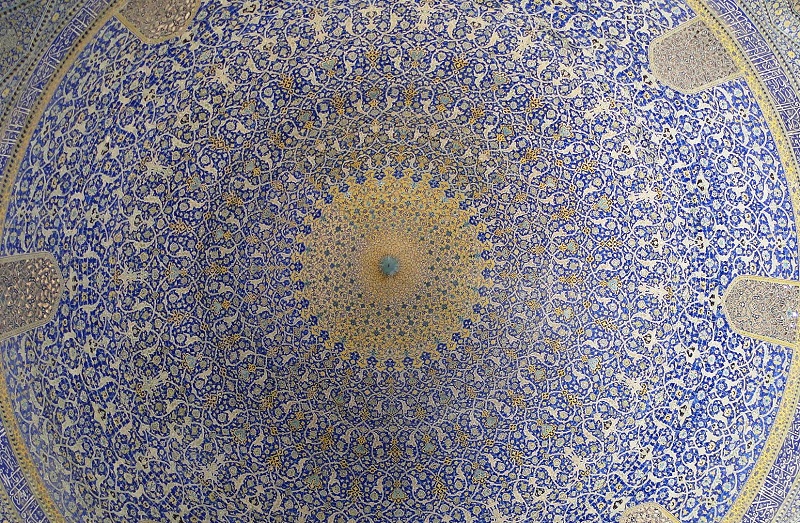
Top 10 Things to Do in Shiraz

Shiraz is one of the most romantic and soulful cities in Iran. Known as the city of love, literature, and gardens, Shiraz welcomes visitors with warm hospitality, rich history, and a relaxed atmosphere that instantly makes you feel at home.

From ancient Persian empires and UNESCO World Heritage sites to colorful mosques, poetic tombs, and delicious local food, Shiraz offers an unforgettable cultural experience.

If you’re planning a trip to southern Iran, here is a curated list of the top things to do in Shiraz β€” perfect for first-time visitors and culture lovers.

Zand (Vakil) Complex

The City of Literature

Nasir-ol Molk MosqueΒ 

The City of Persian Gardens

Takht-e Jamshid (Persepolis)

Ghalat

Pasargadae

Outstanding Mirror Work

Sassanid Archaeological Landscape

Shiraz Bon Appetite

  1. Explore the Zand (Vakil) Complex – The Heart of Old Shiraz

The Zand Complex, also known as the Vakil Complex, is one of the most important historical areas in Shiraz. Built during the Zand Dynasty in the 18th century, it reflects the power and artistic taste of Karim Khan Zand.

Karim Khan Citadel (Arg-e Karim Khan)

This impressive citadel looks like a medieval fortress from the outside, but inside it follows traditional Iranian courtyard architecture. In spring, the scent of orange blossom trees fills the air, creating a magical atmosphere. Inside the rooms, life-sized statues tell stories of daily life during the Zand era.

Vakil Bath

Once a traditional Persian bath, today this beautifully preserved building functions as a museum. Through sculptures and architectural details, it introduces visitors to Iranian lifestyle, customs, and social life in the past.

Vakil Mosque

Vakil Mosque is famous for its elegant design and Haft Rang (seven-color) tiles, a signature style of Shiraz. Its peaceful courtyard and artistic interior make it one of the most photographed mosques in the city.

Vakil Bazaar

Walking through Vakil Bazaar feels like stepping back in time. This historic market is still alive with shops selling Persian carpets, spices, copper handicrafts, antiques, and souvenirs. It’s one of the best places to experience local life in Shiraz.

NasΔ«r al-Mulk Mosque aka "Pink Mosque" | Shiraz

  1. The City of Literature: Hafez and Saadi

Shiraz is the birthplace of two of Iran’s greatest poets: Hafez and Saadi. Their words shape Persian culture to this day.

Β 

Tomb of Hafez

Hafez is the most beloved poet in Iran. His poems about love, spirituality, and life are quoted daily by Iranians. Writers like Goethe and Nietzsche were inspired by his work.

Hafez’s tomb is not just a historical site β€” it’s a spiritual gathering place where locals come to read poetry, reflect, and connect with Persian literature.

Β 

Tomb of Saadi

Saadi, a master of moral and social wisdom, is internationally known and frequently quoted in Western literature. His mausoleum is surrounded by a beautiful Persian garden, mirror work, and tile decorations that create a calm and thoughtful atmosphere.

  1. Nasir-ol Molk Mosque – The Pink Mosque of Shiraz

Known as the Pink Mosque, Nasir-ol Molk Mosque is one of the most iconic landmarks in Shiraz.

In the early morning, sunlight passes through its stained-glass windows and paints the floor with colorful reflections. This magical play of light has earned it names like Rainbow Mosque and Kaleidoscope Mosque.

It’s a dream location for photographers and one of the most visually stunning mosques in Iran.

  1. Discover the Persian Gardens of Shiraz (UNESCO Heritage)

Shiraz is often called the city of Persian gardens, and for good reason. These gardens combine water, trees, architecture, and symmetry to create peaceful green spaces.

Eram Garden (UNESCO)

A historic botanical garden with tall cypress trees, a beautiful Qajar palace, and a long reflective pool. Eram Garden is one of the finest examples of Persian garden design.

Narenjestan-e Ghavam

A charming Qajar-era Garden filled with sour orange trees. The mansion features mirror halls, colorful tiles, muqarnas ceilings, and exquisite paintings.

Afif-Abad Garden

Once a royal residence during the Safavid era, today it houses a military museum. The architecture blends Achaemenid, Sassanid, Zand, and Qajar styles.

Nazar Garden (Pars Museum)

Built before the Zand dynasty and later expanded by Karim Khan, this garden features the octagonal Kolah Farangi pavilion and beautiful greenery.

Other lovely gardens include Jahan Nama Garden and Delgosha Garden.

  1. Persepolis (Takht-e Jamshid) – Glory of the Achaemenid Empire

Located about 57 km north of Shiraz, Persepolis is one of Iran’s most important archaeological sites and a UNESCO World Heritage Site.

Built by the Achaemenid kings, it was used for royal ceremonies such as Nowruz (Persian New Year). The massive columns, reliefs, and staircases still show the power of ancient Persia.

Nearby sites include:

  • Naqsh-e Rostam (royal tombs of Achaemenid kings)
  • Naqsh-e Rajab (ancient rock reliefs)
  1. Ghalat (Qalat) Village – Nature Escape Near Shiraz

Located about 36 km northwest of Shiraz, Ghalat is a mountain village with cool weather, stone alleys, waterfalls, and stair-shaped houses hidden among trees.

Visitors can explore old churches, water mills, and local handicrafts such as basket weaving and traditional shoes (Giveh). Cozy cafΓ©s and traditional restaurants make it a perfect day trip from Shiraz.

  1. Pasargadae – Tomb of Cyrus the Great (UNESCO)

Pasargadae, the first capital of the Achaemenid Empire, was built by Cyrus the Great. Located 140 km north of Shiraz, it includes:

  • Tomb of Cyrus the Great
  • Remains of palaces
  • Ancient garden layout (Chahar Bagh)
  • Caravanserai ruins

It represents the early development of royal Persian architecture.

  1. Outstanding Mirror Work in Shiraz

Mirror work (Ayeneh Kari) is a unique Iranian art, and Shiraz has some of the finest examples.

Shah-e Cheragh Shrine

The third holiest shrine in Iran, famous for its breathtaking mirror-covered interior that reflects light in all directions.

Ali Ibn Hamze Shrine

A peaceful shrine with beautiful mirror decorations and a lovely courtyard garden.

Ghavam House

Located inside Narenjestan Garden, this Qajar-era mansion showcases stunning mirror halls, tile work, plaster art, and symmetrical design.

  1. Sassanid Archaeological Landscape (UNESCO)

Added to the UNESCO list in 2018, this landscape includes eight Sassanid sites in Firuzabad, Bishapur, and Sarvestan.

You can explore ancient cities, palaces, and reliefs from the Sassanid era, enjoy scenic routes, and even visit nomad camps depending on the season.

  1. Shiraz Bon AppΓ©tit – Taste the City

Shiraz is also famous for its food. Don’t leave without trying these local specialties:

Shirazi Salad

A fresh mix of cucumber, tomato, onion, dried mint, and verjuice β€” light, juicy, and perfect as an appetizer.

Kalam Polo

A traditional Shirazi rice dish made with cabbage, herbs, rice, and small meatballs. Simple, local, and delicious.

Faloodeh Shirazi

A famous cold dessert made with thin rice noodles, rose water syrup, and lime juice. The best faloodeh is found near Karim Khan Citadel.

Final Tip

Shiraz is best explored slowly β€” walking through gardens, listening to poetry, and enjoying long evenings with tea and conversation. Two to four days is ideal to truly feel the spirit of this beautiful city.

Is It Safe to Travel to Iran in 2020?

[vc_row][vc_column][vc_empty_space height=”10px”][vc_column_text]

Due to the worldwide spread of coronavirus, the past couple of weeks have been concerning for international travelers everywhere.

At friendlyiran, we’re taking serious steps towardΒ Green TourismΒ and we feel the social responsibility to fight against coronavirus. Therefore, to guarantee our client’s health and safety and prevent coronavirus spread, we have decided to suspend all of our tours to Iran until further notice.

Know More About Iran Travel Advice in March 2020, Here!Β 

[/vc_column_text][vc_empty_space height=”10px”][/vc_column][/vc_row][vc_row][vc_column width=”1/2″][vc_column_text]

Is Iran a safe travel destination?

Iranian people have been always a true sample of friendliness and hospitality especially when it comes to foreigners. They hardly let a passenger be left alone, without say greetings or even just a hello. In fact most Iranians will not let tourist pass without making sure that they have place to stay and food to eat.

Make friendship with Iranians in 10 minutes stay friends forever! Iranians are one of the most if not the world’s most hospitable people and would love to make friends, as long as it’s both side desire.

β€œAnyone who comes to this house, give him food and do not ask about his faith. Because, as he merits a life next to the exalted God, no doubt he deserves a meal on my table”

Abu al-Hassan Kharqani “A great Iranian Sufi”

[/vc_column_text][/vc_column][vc_column width=”1/2″][vc_single_image image=”25250″ img_size=”large”][/vc_column][/vc_row][vc_row][vc_column][vc_column_text]

When you give credit to propaganda and media thousand questions comes to your mind, keeping you wonder; β€œIs it really safe traveling in Iran?! Who should I believe latest travelers comments or state warnings?”

In fact Iran is among low risk travel destination based on International SOS travel risk map in 2019. According to this map, only 8 countries are labeled as insignificant travel risk destination. Meanwhile Iran has got the same safety status as most of European countries; like United Kingdom, Germany, and France.

[/vc_column_text][vc_single_image image=”25259″ img_size=”full”][vc_empty_space][/vc_column][/vc_row][vc_row][vc_column][vc_column_text]

5 Facts about Iran Safety and Legal Security

  • Iranian citizens are not allowed to carry any kinds of weapons or buy or sell them legally.
  • None of the Iranian cities are listed between top 50 most dangerous cities in the world (not in 2018 or before that)
  • For more than fifty years, there have been no outbreak of any diseases or epidemics that threaten the life of people. There are no such diseases as Ebola or anything the same, either.
  • There have been no possibility of any terrorist attack in nearly 15-20 years.
  • You rarely find any specific cases in the media about rape, murder or attacks happening to travelers or tourists.
  • There are some governmental laws for collaboration of ministries and governmental organizations for extra cautions and protections of travelers and tourists.

[/vc_column_text][vc_single_image image=”25254″ img_size=”full”][/vc_column][/vc_row]

visa-free between Iran and Russia

[vc_row][vc_column][vc_column_text]

The Iranian embassy in Moscow confirmed on Tuesday that an agreement between Iran and Russia, endorsed by presidents of the two countries, is going to simplify visa requirements for certain nationals from the two nations.

The Russian Foreign Ministry said in a statement:The purpose of this agreement to facilitate visa requirements for citizens of both countries. Visa facilities for Iranian businessmen and Russian participants in science, culture, art and also the students and tourists.

Apart from financial interests in the field of tourism we hope this is the beginning of economic growth and cultural proximity between two neighboring countries.Β Iran is good marketing as a new and uniqueΒ tourism destination with high potential in the fields of investment and Russian isΒ β€ŒBeautiful and Historical Β destination forΒ Β the millions of Iranian travelers in the year.Β 

Β but you can read aboutΒ iran visa here[/vc_column_text][/vc_column][/vc_row]

The possibility of abolish visas between Iran and Russia

[vc_row][vc_column][vc_column_text]Iran is a safe destination for Russian tourists.

Iran and Russia, two neighboring countries that have much in common historically,These days are going to make positive diplomacy decisions in tourism. An Iranian delegation headed by Morteza Rahmani(Deputy of Tourism) Traveled to Moscow last week on 23 December.Iran is ready to unilaterally cancelΒ Visas for Russian tourists toΒ Iran and Β increased the validity of the visa from 15 to 30 days that tourists receive in Iran’s airports also.

Oleg SafonovΒ head of Β the Russian tourism said:Β Iran is a safe destination for Β Russian tourists.Russian Foreign Ministry has suggested willΒ AbolishΒ  visas for Iranian travelers who travel to the Russia as Group tour.

one of Russian expert expressedΒ “Iran is a new country for us and for our country’s political establishment, we should have mutual understanding. As for tourism, this is a very interesting destination. As for cultural tourism, there are a number of fantastic monuments. It is good that they intend to introduce a visa free regime,”Β 

[/vc_column_text][/vc_column][/vc_row]

Iranian Traditional House

Persian houses are a true reflection of the Iranian culture, beliefs, religion, lifestyle and geographical location. This might be the main reason that Iranian old houses have worldwide fame.

By traveling to a historical country like Iran, anyone would expect to feel like the date is back to old times, to touch traditions in heart and have the chance to live like a local Iranian! As a result, most of the people who travel to Iran, prefer to stay in a traditional accommodation and enjoy the Persian homes atmospheres to make their Iran tour even more exciting or at least visit some historical houses during their Iran travel route.

Iranian Urban Design:

In central Iran, the old quarters of Yazd, Esfahan and Shiraz, by stopping in an old part of these cities and walking in narrow alleys you see how doors are smaller than usual, the house walls are stick to each other and you may not be able to distinguish between two buildings. In central and south Iran most of traditional houses don’t have windows toward alleys and public areas. The Idea behind this kind of house construction was to prevent the dust and sand storms to enter houses and make a safe and private area for family members.

In the meantime houses in North Iran have less privacy and have shared yard with neighborhood.


Different types of Historical and Traditional Houses in Iran

As you see traditional and old houses in each part of Iran are designed based on its geographic situation and traditions. Here we are describing Traditional and historical housing types in Iran.

1. Sunken Courtyard Houses:

Persian houses in Fars, Yazd and isfahan Province have a Sunken Courtyard house, also named as Cave-dwelling courtyard. These houses are a combination of big and small rooms around a main yard. Outside view of houses used to be simple but inside houses, depending on how rich the family were, more ornaments and decoration had the rooms. Big houses had one or two porches connected to a big room, which was called the Kings room or Shah Neshin. Shahneshin and rooms next to it were decorated with colorful glasses, mirror-work, tiling on the roofs, muqarnas covered with plaster and colored tiles and etc. Other rooms were simple, with poor or no decoration.

In the yard a small pond, trees and flowers made a small Persian garden for the family, for children to play and for elder people to talk and gather. Iranian used the pond’s water to wash the fruits and wash their face, hands and foods before doing the praying.

2.Β  Houses in Stepped villages:

Small villages locating between mountains hold different kind of house to its residence. There, houses are made from clay and wood, each house are made in the rooftop of another house and each roof is the court of the upper house. These stepped village are variously found in mountain part of Iran, the most well-known ones are;

  1. Masuleh
Masuleh historical village is located between Rasht and Qazvin, in north part of Iran. Its one of the famous touristic stepped village of Iran which dates back to 800 years ago.
  1. Abyaneh
Known as the best located village in Iran tours. Abyaneh historical village is one of the highest residential areas in Iran. Abyaneh houses made by red clay have made a beautiful scene with the green trees. Local people wear their traditional colorful dress and make the view twice splendid.
  1. Buzhan (Bojan)

The pearl of Neyshabour Tourism! This small village is located in East-North of Iran. This small village is filled with fruit gardens and has a small waterfall. Herbs in Binaloud mountain has been an additional attraction for tourists.

  1. Ushtabin

Just close to the Aras river and Iran Boarder, Ushtabin village is estated like a green diamond. The blue sky, the nature and red deers has made this place a unique attraction. If you step by in this village, don’t forget to taste the special bread.

  1. Palangan

The specialty of Palangan is being rockey stepped village. Its located Kurdestan province, in the Tangiur valley. Palangan historical castel, springs and stepped waterfalls and village have made a great impression on its visitors.

  1. Uraman Takht

One of the famous rural districts in west Iran is Uraman Takht in Kurdistan province. This small village is one of the well-known stepped villages of Iran and lies near Marivan splendid lake.

Best to be visited for Komsay Festival!

  1. Hajij

One of the most attractive villages in Kermanshah, near Uraman region is Hajij Stepped village. Old houses in Hajij are all made by stones in the slanted surface of a valley, with a view of the beautiful mountain and Sirvan River.

  1. Sar Agha Seyed, Koohrang

Being so similar to Masuleh village in Alborz mountain, Sar Agha Seyed village is named the Masuleh of Zagros. This small village in addition to its admirable urban design, has a lot fruit gardens, springs and natural beauties to offer. The people in this village has perfectly saved their traditions, culture and dialect. Best time to visit Sar Agha Seyed near Shahrekord, is spring and summer.

The Koohrang dam which is one of the main sources of Zayanderood River is in route of Sar Agha Seyed Road.

3. Caravanserais:

They may not be considered as house, but caravanserais are the only heritage of historical and traditional inn architecture from 2 thousand years ago. Achaemenid kings have started the construction of Carvanserais over the royal road, and Shah Abbas king of Safavi dynasty continued it over the land of Iran.Β  Carvansaries were a place for trading, publishing the news, a home to homeless people and Sufis and of course the meeting point of travelers!

Here we will quickly mention the top Caravanserais in Iran which give accommodation to today’s travelers;

  1. Abbasi Caravanserai/ hotel in Esfahan

Oldest hotel in the world!

  1. Zeinnodin Caravansarai

It is still hosting travelers, making a fabulous memory of star gazing under the deserts sky.

  1. Shah Abbasi Caravansarai/ Laleh bistoun hotel in Kermanshah

Just next to the Achaemenid Masterpiece, Bistoun bas-reliefs.

  1. Kuhpa Caravanserai

Locating between Yazd –Esfahan, near Nain small city

  1. Rebat Sharaf Caravanserai

Stunning Islamic architecture with tiling and stucco design. Located in Sarakhs near Mashhad

  1. Ghasre Bahram Shah Abbasi Caravanserai

Locating in a desertic area between Tehran and Garmsar, it’s now used as an inn and police station of Kavir National Park.

There are Caravanserais in different shapes of Circle; Zeinoddin Caravanserai in Mehriz, cube; TiTi Caravanserai in Lahijan, cube shape with four tower in the edges; Maranjab Caravanserai in Kashan. Caravanserais are built from China to South Europe and North Africa but they are more frequent in Iran and Turkey.

Sleeping in a caravanserai near Lut Desert or Maranjab is highly recommended. Accommodation in caravanserais is especially beloved because of its unique nights, watching clean sky full of stars of Milky Way and the different room types. It also give the guests chances to walk to the desert and enjoy the sunrise and sunset.

4. Rocky villages:

People from thousand years ago have made houses and homes in Rocks. The houses which are still used as a shelter for local people and guests. Most famous rocky settlements in the world are Maymand and Kandovan in Iran and Cappadocia in Turkey. In cold winter the weather inside the rooms is warmer and in summer its cooler, this special feature made a better situation for living.

  1. Maymand village

One of the most ancient villages in the world is Maymand rocky village. A complex of old rocky houses hand-graved in rocks, temple, castle and towers shows the antiquity of Maymand and its unique civilization. Some Archeologists believe Maymand have been a residential area from 12000 years ago. Meymand is located between Babak city, Sirjan and Rafsanjan in Kerman province. Each house in Maymand is called Kiche and consists of a few rooms, a stable. A part of Maymand village is today hosting travelers from all around the word and provide them a fabulous homey accommodation in rocky shelter.

  1. Kandovan village

How people in Azerbaijan, Iran ended up in settling down in volcanic residue? It should be one of the wonders of the world!

Each Cone has about 40 meter height and consists of 2-3 floors. It’s interesting that these floors are not connected from inside. Normally the first floor is used as stable.

More than a hundred family are living in this village and based on their needs there are also public and social places as mosque, school and bath.Β  Houses in Kandovan have different parts such as main hall, kitchen, closet and they are equipped with canalization and electricity. Β Β 

Most of traditional and historical houses in Iran are now open for visit and they all have second usage like boutique hotels, homestays, museums, restaurants and etc. E.g. Tabatabaei and Boroujerdi house in Kashan, these historical houses are now one of the main attractions of Kashan, with splendid architecture. Ghavam house and Zinatol molk house in Shiraz, it’s a royal house dating back to Pahlavid era with great interior design which is also used as restaurant. Moghadam house in Tehran being used as coffee shop and a small collection of Moghadam collections. Bekhradi and Ghasre Monshi house in Esfahan, which are known as best accommodation in Esfahan. Morshed house-garden in Yazd, a hotel-garden in 3* level dating back to Zand era is one of the oldest houses in Yazd.

Also many small traditional houses in Iran villages have turned into boutique hotels or hostels to serve guests from all over the world. Being more than an accommodation, Iran travelers can feel urban culture deeper, learn Persian culinary, explore the nature, do star gazing and know more about Iranian living style, religion and beliefs. Β Nartiti traditional house in Taft, Ateshouni old house complex in Garmeh village, Sarve kohan ecolodge in Abarkooh are examples of homestays that makes the special moment of Iran trips.

Related Blogs: Top Inns and B&B boutique hotels in Middle east 2017, based on tourists experiences and reviews, Read More.

Iran Travel Guide

Iran Travel Guide

Iran is a country that many travelers don’t know well, and unfortunately, a lot of websites provide unreliable information about it. FriendlyIran, as a local tour operator, offers you the most important tips you should know before starting your Iran tour.

Here are the key things to keep in mind before your trip to Iran.

Overview

Iran is a four-season country with more than 2,500 years of history, diverse nature, and a unique culture. Around the world, many people know Persia (Iran) through carpets, caviar, or oil. Yet, Persia has one of the richest and oldest cultures in the world.

Here is some quick information about Iran:

Iran at First Sight

  • Capital: Tehran
  • Population: 81.16 million
  • Area: 1,648,195 kmΒ²
  • Language: Persian (Farsi)
  • Religion: Islam, mostly Shia
  • Currency: Iranian Rial (IRR)
  • Time Zone: GMT+03:30
  • Standard Voltage: 220 V
  • Frequency: 50 Hz
  • Power Sockets: Type C and F
  • Dialing Code: +98

History of Iran

Recent discoveries show that the written history of Iran began with the early Achaemenids around 3200 BC. Cyrus the Great, the founder of the Achaemenid Empire, is known for creating the first charter of human rights. At its height, the empire stretched from the Aegean coast of Asia Minor to Afghanistan, and south to Egypt.

In 330 BC, Alexander the Great overthrew the Achaemenids. Later, in 641 AD, the Arab invasion began a major transformation in Iran. Zoroastrian Persians gradually converted to Islam. Over time, dynasties such as the Parthians, Sassanians, Samanids, Ghaznavids, Safavids, Zands, Afsharids, Qajars, and Pahlavis rose and fell.

During the Safavid era, Shia Islam became the official religion of Iran. In 1979, after the Islamic Revolution, the Islamic Republic of Iran was established.

Despite invasions and challenges, Iran has always preserved its national identity and developed as a distinct political and cultural entity.

Religion in Iran

Shia Islam is the dominant religion in Iran. However, religious minorities such as Christians, Jews, and Zoroastrians have lived peacefully here for centuries. They have built mosques, churches, and fire temples across different cities in Iran, adding to the country’s cultural diversity.

Iran’s Friendly People

One of the most valuable experiences in Iran is meeting its kind and hospitable people. Iranians are famous for their warmth and generosity. Hospitality has always been a central part of Persian culture, and travelers often find joy in making friends and discovering local lifestyles.

Climate in Iran

Iran is a four-season destination with diverse climates. Winters (December–January) are cold with snow and freezing temperatures, while spring and autumn offer mild weather. Summers are generally hot and dry.

This makes Iran a great place to visit all year round:

  • In summer, you can enjoy sunshine and cool mountainous regions.
  • In winter, you can travel to southern islands or enjoy skiing at Iran’s ski resorts.
  • In spring, you can take part in festivals such as Nowruz, the Persian New Year.

Iran’s landscapes are shaped by mountain ranges. The western part is the most mountainous, with the Zagros and Alborz ranges. The northern region is home to the lush Hyrcanian forests (a UNESCO World Heritage site). The eastern part features deserts like Dasht-e Kavir and Dasht-e Lut, along with salt lakesβ€”perfect for desert tours in spring and autumn.

Iranian Cuisine

Persian cuisine is one of the most complete and diverse in the world. Traditional dishes include different kinds of meat such as chicken, fish, lamb, turkey, and shrimp. Note that pork and alcoholic drinks are religiously forbidden in Iran. Therefore, all food in Iran must be halal (religiously approved).

At the same time, you can also find many good international restaurants offering international dishes and all kinds of fast food across the country.

Restaurants in Iran

  • Breakfast time: around 7:00 am to 11:00 am
    Most hotels in Iran are B&B and include breakfast. You can also enjoy breakfast in local cafΓ©s or restaurants. Traditional Iranian breakfasts such as Halim, Ash, and Kaleh Pacheh (sheep’s head and trotters) are famous, though usually not served at hotels.
  • Lunch time: around 12:00 pm to 3:00 pm
  • Dinner time: around 7:30 pm to 10:00 pm

Most Famous Iranian Dishes

  1. Zereshk Polo – Rice with barberries, usually served with chicken.
  2. Kebab – Grilled meat including lamb, chicken, liver, or ground beef.
  3. Ghormeh Sabzi – Herb stew with meat and beans, with a slightly sour taste.
  4. Dizi / Abgoosht – A hearty Persian stew of meat and beans, traditionally made in stone pots.
  5. Baghali Polo – Rice with broad beans, often served with chicken or lamb.
  6. Ash (Thick Soup):
    • Ash Reshteh – With herbs, noodles, and sour yogurt.
    • Ash-e Sabzi – With herbs, beans, and chickpeas (best with lemon).
    • Ash-e Doogh – With herbs and yogurt whey.
    • Ash-e Kardeh – With herbs and meat.

πŸ‘‰ For more information about Persian cuisine, check our full guide.

Iranian Traditional Sweets and Desserts

  • Ranginak – A national sweet, often prepared during Ramadan.
  • Faloodeh Shirazi – A frozen dessert famous in Shiraz.
  • Bastani Sonnati – Traditional saffron ice cream.
  • Shirini Yazdi – Local sweets from Yazd.
  • Sohan – A brittle saffron candy from Qom.
  • Gaz – A nougat sweet from Isfahan.
  • Halva – A traditional dessert, common across Iran.
  • Kolompeh – A date-filled cookie from Kerman.
  • Masghati – A soft sweet from Shiraz.
  • Zoolbia & Bamieh – Famous Ramadan sweets.

Iranian Foods for Vegetarians

Vegetarians and vegans can also enjoy a variety of vegetarian-friendly Persian dishes during their Iran tour. Some popular options include:

  • Kuku Sabzi – Herb omelet with eggs.
  • Kuku Sibzamini – Potato omelet with eggs.
  • Kashke Bademjan – Fried eggplant with onion and whey (or yogurt).
  • Kate Gojeh – Rice cooked with tomato and potato.
  • Sambooseh – Fried bread stuffed with potato and herbs.
  • Vegetable Pizza – Available in most restaurants.
  • Lubia Garm – Boiled beans with mushrooms.
  • Dopiazeh – Fried potato with onion.
  • Yatimcheh – A stew of tomato, garlic, and zucchini.

Iran Economy

Thanks to its oil, natural gas, and petrochemical industries, Iran plays an important role in the global economy. The country’s economy is a mixture of central planning, state ownership (especially of oil and gas), agriculture, private trade, and services.

Iranian Currency

The official currency of Iran is the Rial (IRR). However, Iranians commonly use Toman, where 1 Toman equals 10 Rials. This may be confusing for travelers at first.

You can exchange USD and EUR in banks and exchange offices, available in airports and major cities.

πŸ‘‰ For more details, check our guide on Iranian currency.

Iran Tourist Card

Since international credit cards (Visa, MasterCard, debit cards, traveler’s cheques, and ATMs) do not work in Iran, travelers usually carry cash. To avoid carrying large amounts of money, you can get a Tourist Cardβ€”a type of local debit card that works with ATMs, POS machines, and online payments. Although there is a small service fee, it is a safe and convenient way to manage money in Iran.

Iran Dress Code

The dress code in Iran may be different from what you are used to, but it can be an interesting experience to try.

  • For women: The usual clothing is a manto (similar to a light coat), a scarf, and pants. In some holy places, women should wear a chador, which is usually available at the entrance.
  • For men: The dress code is simpler. Shorts and tank tops are not allowed, but otherwise men can dress like anywhere else in the world.

You are free to wear bright and colorful clothing.

Iranian dress code full guide

Iran Handicrafts

Handicrafts are often seen as symbols of a country, and in Iran, they also make some of the best souvenirs. Thanks to Iran’s ancient civilization, rich culture, and diverse geography, you will find a wide variety of handicrafts, each region offering something unique.

The Most Famous Iranian Handicrafts:

  • Persian Rugs & Carpets – The best ones are woven in Tabriz, Isfahan, Shiraz, Kashan, and Tehran.
  • Minakari – Enamel work on metal, best made in Isfahan.
  • Khatamkari – Inlaid marquetry work, mostly from Shiraz and Isfahan.
  • Copper Work – Famous in Shiraz and Isfahan.
  • Cotton & Termeh (Handwoven Fabric) – Best in Yazd.
  • Ceramics & Pottery – Well known in Yazd, Shiraz, Kashan, and Isfahan.
  • Miniature Paintings – Delicate Persian art, best from Shiraz, Isfahan, and Tehran.

Iran Souvenirs

Besides magnets or statues of attractions, you can buy authentic handicrafts and delicious Persian sweets as gifts. While shopping, make sure products are genuinely made in Iran, as bazaars sometimes sell imitations.

Popular souvenirs also include agricultural products such as saffron, pistachios, and caviar.

Tarof

If you travel to Iran, you will encounter unique cultural customs. One of the most famous is β€œTarof”—a traditional form of politeness and hospitality. A host may insist several times when offering food or services. As a guest, it is polite to accept after the third offer. Tarof reflects the generosity and friendliness of Iranian culture.

WiFi, Internet & Social Networks in Iran

During your Iran tour, you can use free WiFi in most hotels, cafΓ©s, restaurants, and malls. However, for cheaper local calls and mobile internet, it’s best to buy a local SIM card upon arrival at the airport or from licensed shops.

The two main providers are MTN Irancell and Hamrah Aval (MCI). You can purchase a prepaid (Etebari) SIM card at a reasonable price, and it will be activated after registration. Using your SIM card’s instructions, you can buy internet data, recharge your balance, and check account details.

Social Media and Websites in Iran

  • Available without restriction: WhatsApp, LinkedIn, Instagram.
  • Blocked: Telegram, Facebook, YouTube, Twitter (but accessible through VPNs).

Iran Visa

Citizens of most countries need a visa to enter Iran, except for Armenia, Azerbaijan, Bolivia, Georgia, Lebanon, Malaysia, Egypt, Syria, Turkey, Venezuela, China, and Hong Kong–Macau.

Visitors can travel to Kish Island and Qeshm Island without a visa for up to 14 days.

Iran Visa Application Process:

  1. Apply for your visa code online.
  2. Pay the visa service fee.
  3. Receive your visa tracking code.
  4. Collect your visa at an Iranian embassy, consulate, or airport.

Iran Traditional Houses

Iran is famous for its traditional houses and boutique hotels. Many are restored caravanserais or historic mansions, while others are newly built in the same traditional style.

Staying in a traditional hotel or local home allows you to experience Persian hospitality and culture up close. Budget travelers can also stay in eco-lodges, hostels, or homestays, where bathrooms may be shared and sometimes mattresses replace beds. In spring and autumn, you can even stay in nomad tents for a unique experience.

Working Week in Iran

The official workweek in Iran runs from Saturday to Thursday at noon. Government offices and ministries are closed on Thursdays. The weekend is Friday, when most bazaars and businesses are closed.

Embassies and consulates are closed on Fridays and also on one additional day (usually Saturday) as well as national holidays.

Events in Iran

Iran has both national and religious holidays, which are important to consider when planning your trip.

πŸ‘‰ For more details, see our full guide to Iran festivals and holidays.

  • Nowruz (Persian New Year): Celebrated from March 21 for 13 days. Families gather around the Haft-Sin table, pray for a good year, eat sweets, and exchange gifts. Tourist attractions are often crowded during this period.
  • Mourning Ceremony for Imam Hussein: Held on Tasua and Ashura, followed by Arbaeen. People gather in the streets to honor Imam Hussein, and many attractions are closed.
  • Ramadan (Ramazan): The holy month of fasting. Eating in public during daylight is restricted. However, hotels serve meals, takeaways are available, and restaurants open after sunset. Grocery stores remain open during the day.

Medical Tourism in Iran

Iran has been famous for its skilled doctors for many years. Today, many people from around the world travel to Iran for medical treatments because of its advanced hospitals, affordable services, and professional specialists. The main medical tourism destinations are Tehran, Shiraz, and Mashhad, where visitors can receive high-quality care in modern facilities.

Shopping Centers and Bazaars in Iran

Iran’s traditional bazaars are must-visit places full of history, handicrafts, and local products. Keep in mind that most bazaars are closed on Fridays and usually operate until sunset.

In Tehran, modern shopping malls are open all day, while in other cities, shops and malls often close for a short siesta between 1–4 pm. Whether you prefer traditional marketplaces or modern centers, Iran offers both experiences.

Drivers and Guides in Iran

Full-time Tourist Guide

Tours with a full-time guide include an expert accompanying you for about 8 hours per day. Your guide will assist with arrivals, departures, hotel check-in and check-out, and provide detailed explanations at all sites.

Local Tourist Guide

A local guide will join you in the main cities for about 8 hours per day and share insights into the history, culture, and highlights of each destination.

Drivers in Iran

Professional drivers are available for travelers. They are familiar with roads and attractions, and while their English may be limited to basic communication, they ensure comfort and safety during the journey. Standard working hours are 8 hours per day.

Vehicles

Travelers can choose from different vehicle options depending on group size and comfort preferences:

  • VIP Cars
  • Standard Sedans
  • Van A36
  • Van A50
  • Mid-size Buses
  • VIP Buses
  • Regular Buses

Iran is one of the few four-season countries on the earth. Spring starts from mid-March and ends in mid-June. Then the summer starts and lasts till mid-September that is hot and dry in most parts of the county. The next three months form Fall that has mild weather. Finally, winter that starts in December and ends in February, is very cold with snowfall in most regions, except the south of the county.

The high season in Iran is from mid-February until the end of May. And, in the second half of the year is during September and October.

The answer is yes. Regarding the Islamic rules in Iran, all tourists should follow Hijab.

Woman dress code:Β  women should cover their hair, wear long sleeve blouses, and long pants.

Dress code for men: They should avoid wearing walking shorts and tank tops.

Here are the top 5 Persian foods:

  • Chelo Kabab (barbecued meat with rice)
  • Khoresht Ghormeh Sabzi (Persian Herb Stew)
  • Khoresht Fesenjan (Persian Pomegranate Stew)
  • Dizi (Persian broth)
  • Tah Chin (Persian dish of layered meat and rice)

Β 

Instagram is the popular social media in Iran. Iranians also use WhatsApp while Facebook, YouTube, Twitter, and Telegram are banned in Iran. Please note that Google and its applications are not banned in Iran. Using Virtual Private Network (VPN) helps you access those banned medias in Iran.

The must-see Iran cities are: Tehran, Isfahan, Shiraz, Yazd, Kashan, Kerman, and Tabriz.

There are 24 UNESCOΒ  Heritage sites in Iran that 22 of them are cultural and 2 of them are natural. Here is the list of Iran UNESCO sites:

  • Armenian Monastic Ensembles of IranΒ 
  • Bam and its Cultural LandscapeΒ 
  • BisotunΒ 
  • Cultural Landscape of MaymandΒ 
  • Golestan PalaceΒ 
  • Gonbad-e QābusΒ 
  • Historic City of YazdΒ 
  • Masjed-e JāmΓ© of IsfahanΒ 
  • Meidan Emam, EsfahanΒ 
  • PasargadaeΒ 
  • PersepolisΒ 
  • Sassanid Archaeological Landscape of Fars RegionΒ 
  • Shahr-i SokhtaΒ 
  • Sheikh Safi al-din Khānegāh and Shrine Ensemble in ArdabilΒ 
  • Shushtar Historical Hydraulic SystemΒ 
  • SoltaniyehΒ 
  • SusaΒ 
  • Tabriz Historic Bazaar ComplexΒ 
  • Takht-e SoleymanΒ 
  • Chogha ZanbilΒ 
  • The Persian Garden
  • The Persian QanatΒ 
  • Hyrcanian Forests
  • Lut Desert

Iran Fritillaria

[vc_row][vc_column][st_gallery st_col=”4″ st_images_in=”6527,6528,6529,6522″][vc_column_text]

Fritillaria: The upside down tulip has either stooped before Iran
Fritillaria flower which comes in red, yellow, and sometimes orange spreads over Iran’s lands after winter, and makes the lands beautiful at springs. Its life span is short and flowers at the end of Farvardin (April) and cease flowering at early Ordibehesht(May) as rain falls begin. Fritillaria has an ancient trace in Iran and its role could be seen on the top of Sasanid pillars and Taghe Bostan museum next to the Sasanid king. This flower owns a specific position in Iranian literature. In one of the Iranian old stories named β€œSiavash” this flower becomes upside down in order to grieve on the heroes innocence and never stands up again. Therefore, because of this story it is also called the tears of Siavash. People from antiquity believed that its upside down position and frost falling down is because of this catastrophe. This plant is in the category of poisonous plants while it is still utilized as a tranquilizer for rheumatic and joint aches. It is also used in purgative process of liver and traditional remedies. For the first time this plant was taken to Austria by European tourists who has visited Iran. It was then planted in royal families’ gardens, and from 19th century became common in Netherlands plant growing industry. As it was globalized it influenced many of the great artists and their works like Goethe. Therefore its beauty was granted to all mankind.
This generous plant which only lives for three weeks is magnificently beautiful and grants its beauty to every one.Β It is some how like seeing heaven when you open your eyes and see thousands and thousands of this flowers and silence knowing that no human being has ever planted them. This plant grows in mountainous regions of Iran and spreads wildly over Iran’s west part of Iran and dyes Zargros Mountains. You can see that this plant is most of all dense in Fritillaria lands of Chelgard region located in Chehar Mahal Bakhtiari province.
The Fritillaria grows and slowly cries at springs after is has passed the hibernation, and gives you spirit with its beauty. Its generosity grant you the medical benefits and the only think it asks for is to stay next to its own kind in the mountainous lands because it doesn’t survive more that 2 hours in any where else. It looks as if this plant, which is the symbol of its region, has upside down position before great creations and magnificence of its land.

Please check it out the tour of this blog in our website.

http://friendlyiran.com/st_tour/iran-fritillaria-tour/

[/vc_column_text][/vc_column][/vc_row][vc_row][vc_column][/vc_column][/vc_row]

Pomegranate Celebration

[vc_row][vc_column][vc_column_text]

Owning the first place of producing pomegranate, Iran has many things to offer about this amazing fruit and the derived products. Pomegranate trees with their bacciferous fruits have had a long history in Iran. These trees were planted in temples in the era of Zoroastrianism. People use to burn its woods in order to get hidden devils out of their houses as being the β€œFruit from Heaven”. They actually pasteurized their houses by doing so. Pomegranate also has a special position in traditional or folk medicine and scientists like Avicena and Abu Reyhan Birooni have written a lot about its advantages. Pomegranate crystal seeds are useful for the heart, cure stomachache, delay senescence, and keeps you safe from cancer and Alzheimer’s disease. If you drink a glass of pomegranate juice every day, you have done your body a great favor ? Many great literary men have also utilized it in their poems and proverbs. They have analogized the shy red faces to the color of a pomegranate. A heart filled with grief is also compared to a broken pomegranate.

Harvest celebrations are held in Iran just like any other place in the world. In pomegranate celebrations,Β farmers play traditional local music while they are picking pomegranates. Children wear beautiful colorful clothes, youngsters play local games and farmers represent their crops and many other products from pomegranate. People celebrate this occasion in several parts of Iran while the most outstanding of them isΒ in Saveh or β€œthe city of red ruby”. At the beginning of fall, this celebration is held for five days in Saveh. After you pass an hour and a half driving on Tehran-Saveh highway, you will see pomegranate gardens in Saveh no matter which way you have selected to enter the city.

Pomegranate plays an important role in Iranian traditions like Yalda night when people gather around with their families and celebrate the first night of winter. Pomegranate always reminds Iranians of those warm days…

[/vc_column_text][st_gallery st_col=”4″ st_images_in=”6485,6487,6488,6490,6491,6489,6492,6493″][/vc_column][/vc_row]
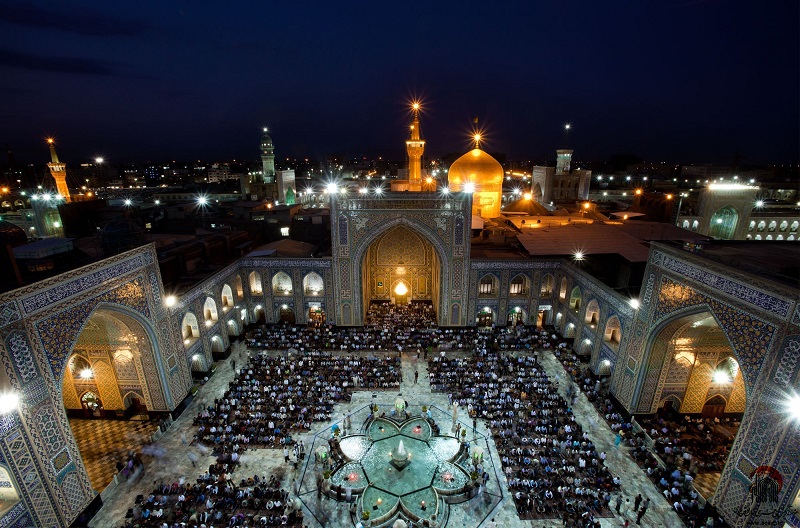
Iranian Bazaar

[vc_row][vc_column][vc_column_text]

Β You probably have almost always visited mall centers with modern facilities and architecture in order to purchase your requirements. However, you may find it interesting to buy from shopping centers which have maintained their traditional architecture and their traditional local stuff. The idea of making places in which all human being requirements or needs are available (by which so much time is saved) requires some extra attractions which have been noticed by traditional Iranian architectures. No matter where your destination is, and which city you are traveling to, while you are in Iran, you will see traditional bazaars built in a linear straight line. Within these bazaars, there are several small stores which are called β€œHojre”.Hojre provides stuff for sale like other types of stores. The first floor includes types of Hojre that are mostly stores or workshops. Bazaars that are of more than two floors allocate the upper floors to different sorts of offices. Hojres are designed in a form that situates them fifty or seventy centimeters higher from the surface of the ground. The reason for this type of design is for the customers to see inside of the stores better, besides, through such a design the appropriate distance between customers and salespeople are maintained by the counter.
Most of the bazaars have mosques, public bathrooms, and cafes close to themselves in addition to shopping centers. Such sections help all the economical and social aspects of the area to survive. Nowadays, big and famous shopping centers have followed this formation strategy based on the needs and the culture of their country. The existence of beautiful arcs, roofs, windows, pleasant smell of plants, condiments, the most traditional Iranian cotton, and copper dishes, make your plan and spend your time visiting these places on your trip.

[/vc_column_text][st_gallery st_col=”4″ st_images_in=”6347,6352,6353,6354″][vc_column_text]

Here we introduce you to some of the most prominent bazaars in Iran:

Vakil Bazaar, in Shiraz: This bazaar is considered as one of the oldest and most traditional bazaars in Iran. It is located in the center of the city (Shiraz). A collection of traditional and historical attractive places like mosques, public baths, and castles are established in this area. This bazaar is one of the longest bazaars in Iran to which you are attracted after seeing its traditional architecture. In the past, it was considered as the heart of Shiraz economics, while these days it is a bazaar that sells special stuff and is of high value as one of the attractive touristic places in Shiraz. Nearly all sections of it are specialized for selling an especial sort of good. Like other shopping centers all around the world, this bazaar contains draperies, crystal shops, crafts like Iranian Khatam, jewelry, and etc. therefore, if you are interested in such stuff, do not lose the chance of visiting Saraye Moshir in this bazaar. You can try some of the most famous Iranian, or it’s better to say Shirazian sweet, (Falude and Bastani) in Vakil Bazaar. Another attractive place which is located close to Vakil Bazaar is the ancient Khan School. If you are interested in Iranian nonalcoholic drinks, you can buy them with the best quality in this collection. From the south extreme of the bazaar, we will reach another bazaar which is called Saraye Moshir. Not only this bazaar provides you good souvenirs, but you will also be attracted by the Iranian traditional architecture of its structure. In the middle of this bazaar (Sarayr moshir) there is a beautiful rectangular pool next to which you can have a break and take pictures.

Naghshe Jahan Bazar, in Isfahan: This bazaar is made up of two floors in which there are two hundred Hojres. These hojres are located around the Naghshe Jahan Square, and the stuff that they provide are Iranian handmade crafts. This bazaar is known as one of the biggest bazaars in the world. It has been registered in UNESCO universal inheritance system. This bazaar is contained of four incredibly attractive constructions: Sheikh Lotfolah Mosque, Emam Mosque, Alighapu Castle, and the entrance of Ghesarie Bazaar. you need to have at least a whole day free to visit this bazaar completely. Moreover, this bazaar is the heart of handmade crafts and the original art of Iranian artists. Perhaps one of the attractions of this bazaar is that you can see artists working in the workshops of the bazaar in person. Arts like khatam Kari, Monabat Kari, carpet making, cotton printing, and Vitreous enamel are among numerous arts that are common in this bazaar. You can buy souvenirs from this bazaar in order to keep sight of Iranian original art and architecture. Visiting this bazaar has inspired so many authors to write memories about it.

Great Bazaar of Tabriz: Tabriz Bazaar having a 1 square kilometers area is one of the biggest top-moving Bazaars in Iran and the whole world. It has been registered in UNESCO universal inheritance system as the first bazaar in the world. In the past, it has been in the Silk Way and was considered as one of the economic hot spots in the universe. You can see Iranian art and manmade crafts in this bazaar and others like crystal selling bazaars, shoemakers’ bazaars, and carpet makers’ bazaars. Being one of the most beautiful great bazaars, it has been known for its chain structure and winding alleys. The old age of this bazaar resembles Iranians’ commercial experience from a long time ago. If you are interested in Iranian rugs, you may see the best samples of Iranian rugs with variety in color in this bazaar.

Kashan Bazaar: This Bazaar has been famous since old times because of its amazing architectural organization, and spacing strategies that have been utilized in it. Meanwhile, this bazaar is another sample proof for Iranian arts like coppersmiths’ art which is one of the most common arts in this bazaar. If you are traveling to Iran, make sure that you visit this city while you are traveling on the Isfahan-Tehran road. Further than visiting historical and architectural monuments, try to visit and settle in the traditional houses of these bazaars.

[/vc_column_text][st_gallery st_col=”4″ st_images_in=”6357,6358,5482,6360,6363,6364,6365,6366″][/vc_column][/vc_row]
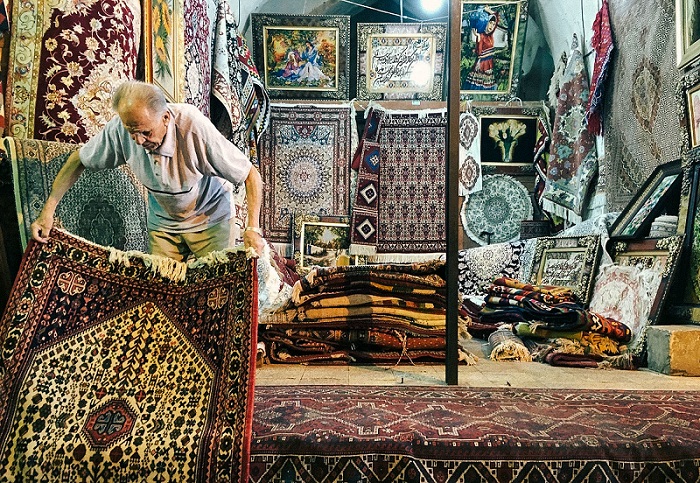
Iran nuclear deal and the future of tourism

Β You may have heard a lot of news about the nuclear negotiation between Iran and the 5+1 assembly. The result of this negotiation and the decisions that are made by political heads will take care of Iranians’ fortune and perhaps the future of many countries all around the world. Presumably, history will judge the final decision!!! However, this decision will have a strong influence on the economy, political relationships, cultural, and touristic aspects of the whole world.

Let’s accept this truth that without boundaries that make countries of different names and people with different originalities, whatever exists in the world belong to Him, and we are all a big family. Iran is a country willing to be friendly, however, these days some of his brothers and sisters are cruel to her. History and civilization have included all of us. Perhaps our ancestors were thinking about bringing peace and equality in the world while they were building Persepolis 2500 years ago. Perhaps they were trying to keep human dignity safe and establish a world without slavery with their art and intelligence. These people would have never thought of being forgotten by the rest of their families. It is not hard to follow if we say that apart from all around the world is included in Iran. A country that is the source of primary civilizations and natural attractions will for sure be a good target for the tourism industry. This industry will remind us that whenever we are tired of routine life, we can travel around the world and without any distortion help our minds find their peace in nature. We can perceive the glory of our ancestors in monuments and fragments. We can also have a smile from our brothers and sisters of long distances in our pictures. By doing so, we will find family everywhere and the most relaxing place ever.

Nowadays, there is a wrong image made about Iran outside of its geographical boundaries. You can find any reason and excuse in Iran that will make you willing to go to a country. If you are interested in nature, you will find the four seasons in this country. Considering herbal and animal species and all of the geological and biological sections, Iran is a rich valuable country. In this country, you will experience great forests on the north side, vast islands on the south side, mountains covered with snow on the west, and great desserts in its center. Whatever city and province you choose to visit in this country, you may not miss visiting monuments with thousands of years of history with a special architecture that you will see nowhere else in the world. Even if you can not stay for long, visiting cities like Shiraz, Tehran, Isfahan, and Yazd will suffice to see my words. You will experience ethnic food, clothing, architecture, music, and artificial man-made crafts in every city of this country so numerous that you will be truly excited. Unfortunately, having these privileges, Iran couldn’t have the chance to be the house of many members of the great family, however, those who have tried visiting this country have changed completely positively toward it. Eventually, Iran has not been justly presented to the ears all around the world.

Maybe if there weren’t any political trends around the world, people could have experienced a better significance of the word β€œfamily”. β€œRick Steves” the American adventurous movie director, has changed his view about Iran after his travel to this country. In the story he wrote about the time he had traveled to Iran, we will read that he was waiting for men with knives and guns in the plane, while he saw calm civilized people sitting next to each other. Tehran, the capital city of Iran, was just like other capitals around the world. He said that he could see the culture and magnificent architecture in Isfahan, and feel the glory of ancient civilization in Persepolis. He mentioned people who were smiling and were eager to start a conversation with you. He says that statesmen will come and go but people will always stay. We hope that whatever decision is made after these negotiations, there comes a time when all the brothers and sisters around the world will gather together in our country just the way it has once carved on Persepolis walls. We hope people will see Iran as part of their own history that is waiting for its family.

Peace Making Alleys

In today’s modern world, development in technology has made our life a better facilitated one, but wherever we are in this vast great world, we need a moment to get out of this fast time machine in order to seek out our childhood good memories and peaceful traditional moments, remember our old houses and memories that we have missed so long.Β Walking in old alleys may remind us that golden moments and help us feel better.

Iranian old alleys and houses have their own specific stories reflecting the culture of their ancient residents filled with pleasant memories. When you step out of the old houses designed artistically by the old-style architecture, at the first glance you would be attracted by the flowers that have embellished the walls of these houses’ halfway height and their lovely fragrance fills the whole alleys. No vehicle could pass through the alleys, therefore next to every house, a platform was designed for those who wanted to take a breath. These platforms are also a good place for women to gather around in the evenings for friendly talks. The alleys that were close to shrines and holy places were designed in a way that the domes were clearly seen from most of the doorways. If these alleys were close to Bazaars, they ended at the entrance of a specific corridor of the bazaar. So, sometimes to reach the main street the people were supposed to pass marketplaces and corridors.


Ghahr-o Ashti alleys:

You may find this story interesting. In the past, some of the alleys in Iran were built so narrowly that only one person could pass at a time. Therefore, if two people were walking in the opposite directions simultaneously they would inevitably come across and in the cases that they were mad with it became an excuse to say hello and put aside any annoyances.

If you are eager to travel to old Persia and feel the peaceful atmosphere of the old quarters, try visiting β€œGhahro Ashti” and other winding alleys, there are still such places in ancient cities like Shiraz, Yazd, and Kashan.

Qeshm the Island of seven Wonders

Qeshm Island, one of the most amazing Iran destinations, is known as the island of seven wonders.
The wonderful island of Qeshm, located in the south of Iran, is the biggest island in the Persian Gulf. This piece of land surrounded by smaller islands in the middle of the blue waters forms a breathtaking nature that is so unique in terms of geology and geography.
In this article, we present some of the major attractions of this region.

Β 

Qeshm Geopark

Geopark of Qeshm Island is the first geopark in the Middle East and has been recognized as one of the UNESCO-sponsored Geoparks since 2006. Geopark is an area in which are several geological phenomena. It may also have historical, ecological, archaeological, and other cultural and natural heritages in addition to geological phenomena.Β 

This area consists of 25 Geosites, including Star Valley, Qeshm Roof, Tandis-ha Valley, Shur Valley, Chah Kuh Canyon, Karyan Canyon, Karagh Beach, Ghazi Valley, Naz Island, Hara Forest, Turtles nesting beach, Loft Village,Β Khorbas Cave, Dokoohak birds’ wetland, etc.

Stars Valley

This site represents one of the most beautiful geological appearances in the Persian Gulf that formed by Erosion of sedimentary rocks. Regarding a folk tale, β€œonce upon a time, a huge star fell on the village and made a design on the soil and stone, resulted in this strange shape.” Although this place is marvelous during the night for star observing and the stars look so close that can be touched by hands, it is very scaring due to air flowing in the valleys making strange sounds.

Hara Forest (Mangrove)

The combination of hot and dry climate with saltwater provides conditions for the growth of the Avicennia marina tree in Qeshm. This plant is a kind of Mangrove tree that forms Hara Forest in the Qeshm Geopark.

Mangrove trees that can grow in saltwater, cover more than 2000-kilometer square of the Qeshm Island. These trees grow to heights of three to eight meters and has bright green leaves and twigs and usually bear sweet almond-like fruits from July to August. You can go with a boat among the beautiful trees and enjoy the unique nature and silence of this forest.

Salt Cave

If we move toward the west of Qeshm Island far from the downtown, we reach one of the most beautiful masterpieces of nature. This mysterious site is like a vacant and unknown place in the world. It is the longest salt cave on earth with more than 6 km length. According to recent researches, breathing in the caves is useful for curing asthma.

Talla Wells

Situated 30 km from the international airport of Qeshm, these wells formed the Achaemenid and Zoroastrian-era water storage technology that stored the clean rainwater and kept it cool for a long time. Each of these wells was dug in a different geometric shape. The number of wells is 366 that returns to the numbers of the days in the year that on each day, the people opened the door of one well and used the water.

On top of these wells, there are two garrets monuments date back to the 17th century. On the other hand, the windcatchers of the Loft village on both sides of this historical landscape create a marvelous view.

Chahkooh Canyon
A magnificent 100-meter deep valley known as the Chahkuh Strait lies at the eastern part of Qeshm Island which amazes many visitors with its special features. During thousands of years, all natural elements, including wind and water, have worked together to form this beautiful geological appearance.

Portuguese Castle
This rectangular fortress was built on an area of more than two thousand square meters in 1507 for militaria purposes by a Portuguese general named Afonso de Albuquerque. The castle architecture is a combination of limestone and gypsum with local mortar of the Qeshm Island.

Mankind’s kind and clever friend

Mankind’s kind and clever friend

Dolphin
Mankind’s kind and clever friend

Dolphins have for long been recognized as mankind’s friend in the legends and myths of different nations. Their figures are carved on stones. Greek ancient coins signify a man (god) riding over a dolphin. In Iranian culture, dolphins are seen beside shells, pearls and lilies, which are three symbols for patriotism.
There are several behaviors attributed to these animals which are of high attraction for mankind:
For sure you have already heard that dolphins are too smart and learn so fast. On of their privileges is their hearing ability which is so powerful. They use this adjective for determining locations. Studies have shown that dolphins use their hearing power to imagine several figures. Therefore each sound signifies a thing in their mind. They actually see through hearing.
Its skin is a protection against water. Their skin is gray on the top of their body. The skin of its stomach camouflages with the color of the seafloor and makes it hard to find underwater.
They spend several hours of a day to cradle each other. They are living in group style and are social animals which live together. If you separate them from each other they will be depressed and that may even eventuates in their death. They know how social life is valuable.

Apart from altruism, this kind animal has proved its loyalty to human being for numerous times. They help men in fishing and if a shark is going to attack a man, dolphins will secure them by swimming around them in a revolving way. They also use to visit their old friends on the beaches without any fear.

If you want to travel to Iran, do not miss visiting these beautiful creatures in Gheshm which is an island located in the north of Hormoz strait. Since the picture of this island is like a dolphin, it may be deeply related to these animals. One of the most attractive things in this island are dolphins. When you are wandering around in a boat in blue waters near the island, you may see bunch of dolphins coming out between boats as if they are welcoming you.

Travel customs in Iran

Travel is always an enjoyable part of our life. Going and visiting the astonishing differences of the world, beauties and having good memories could be another good point of traveling. Each person has/his own reason for travel such as business, pilgrimage, leisure and etc; but all have a common effect on one’s life and it is decision making to leave our home, family, and friends and step into a way of experiencing the world. In Persian culture, when someone of dearest goes on a journey have a special traditional and fascinated custom that may be interesting to you. All the ceremonies that are done for a traveler are with the aim of wishing safe travel, Custom such as pouring water behind of traveler( after his/her left home), passing under the Quran before traveling, cooking Ash(kind of stew-like soup that cooked someday maybe about a week after his/her left home) and …

pouring water behind of traveler: Water has always been holy in Iranian culture and pouring water behind loved ones who have decided to travel, is the symbol of wishing safety for the traveler in his/her travel. There is an interesting story dates back to the Sassanid era and one of its governor named Hormozan. He arrested and took to Medina (Saudi Arabia) and Khalifa ordered to kill him. Hormozan asked for a little water before being killed, But he lingered in drinking water, and when was asked the reason; he stated I fear to kill me and Khalifa guaranteed he will be safe until he drinks. Suddenly he poured the water on the ground and Khalifa, who defeated by the intelligence of the Persian governor, kept his promise and let him went. it is the story that led to this custom.

Passing under the Quran: Although the trips are not as difficult as in the past, always we are concern about our dearest having a safe trip. One of the Iranian traditions for passengers is passing under the Quran. When passengers are ready to travel, at the time of goodbye, they pass three times under the Quran(the holy book of Muslims) to be safe during his/her trip.

cooking Ash: About Three days after travel, the traveler’s family or loved ones make Ash( kind of food like soup, ingredients used are reshteh (thin noodles), onion, chickpeas, black eye beans, lentils, herbs such as parsley, spinach, kashk (a whey-like dairy product), oil, salt, and pepper) and share it to their neighbors and relatives to make good wishes for the traveler for having a good and safe trip and to show that they are in the memory of the traveler.

Tea in Iran

tea in iran

We all have stress in this modern world and in our routine life days, so we are looking for solutions to reduce these stress. The tea and coffee based onΒ  a medical and scientific research are good ones for dealing with these stress and a cup of any of these is a good way for starting a new day.

Even these routine things that are based on culture of any country can be interesting for other people, Just imagine that for buying your daily favorite coffee, stand in a long queue and perhaps in these long lines you will find friends :);Or British afternoon tea which perhaps reminds you the beautiful dishes and delicious sweets, and interesting formal Japanese tea ceremony that wearing their traditional dress with the special way of drinking in cupsΒ handles.

Iranian tea house

Most of people drink tea in Iran and this traditional drink, beside medical benefits ,has social aspects that could be interesting to you. Tea in Iran is served in family parties and important events , such as traditional marriage ceremony which is first formal visiting of two families.

In the past, tea Β was served in narrow waist cups (Kamar Barik) on a saucer that is still served the same way in tea-house.

persian-tea-in-estekan.kamar barik

The cup has cylindrical form that is narrow in middle part. But there is a reason for using these kinds of cups ; By keeping the scraps of tea leaves in the bottom ,it help usΒ  to drink easier.

tea house in iran.

Teahouses are not just places for drinking tea and spending free time, they also have special role in tea in iran-kamar barik glassIranians social life.

In the past ,there Β was Β a person in tea houses Β who was called Naghal (narrator) and his role was telling the literal-historical stories in an Β attractive way . Those stories weren’t only story but also had some inspiration which were full of informative tips.

Architecture of these places are derived from the traditional houses and you can see the beautiful paintings on the wall of teahouses. so if you have trip to Iran visiting these places would be interesting.

Iran Unique Tea Houses (chai Khaneh)

Haj Ali Darvish Tea House: There are many tea houses in Tehran grand Bazaar, the most interesting one is Haj-Ali Darvish tea house. It is the oldest and also the smallest cafΓ© in Iran. The menu contains different kinds of Persian style tea, coffee and hot chocolate. There is also a gift for each traveler, a welcome coin.

Azari Traditional Tea House: Traditional Persian foods are another part of some menus in Iranian tea houses. Azari tea house located near the Tehran train station is one of the bests in serving Dizi and Kashke Bademjan.

Azadegan Tea House: Located in Naqshe Jahan Square of Isfahan, Azadegan tea house has lots of visitors from all around the world. Antiques hang from the walls and ceiling needs lots of time to be explored.


Abbasi Tea House: The beautiful architecture of Abbasi tea house of Kashan in addition to its delicious Persian foods and drinks are reasons of this cafΓ©’s popularity. Friendly waiters are ready to follow your orders…


Take a break, sit back and relax, while we take care of your travel arrangements. Choose from a range of our tour packages, whether with inclusive flight tickets or without. Our custom-tailored packages guarantee an unforgettable experience with memories to cherish.

IRAN VISA SERVICES

Our visa experts ensure seamless and timely processing of Iranian visas. From tourist andΒ  visas toΒ  for permanent residents and business, we provide end-to-end services tailored to your specific needs.